


I tried really hard not to use this particular image to represent Saul Steinberg’s work. I really did. Everyone’s seen it, and it’s not like there aren’t a multitude of wonderful and memorable Steinberg images to choose from: the clock with all of its numbers replaced with the word “Now”, the days of the week leaping, marching and crawling across the page in approximation of our emotional response to them, the dog making colorful visible screeching on a violin, the venetian blinds that reveal a man and woman behind them to be on different planes of existence, the man standing at the convergence of the visible lines that make up his life (labeled: latitude, longitude, February, 4pm, doubt, duty, etc.), the artist painting by water that reflects the entire scene, including a reflection of her painting of the reflections,… the list goes on.
But this image, Steinberg’s image of the world as seen from 9th Avenue in Manhattan, regardless of how many posters and cards and prints and shower curtains the damn thing appears on, no matter how familiar it is or what a cliché it’s become, this image still grabs me every time. I love it.
It doesn’t just make a wry comment about the Manhattan-centric view of the world that New Yorkers have; it says something about all of us and the way our brains map out the world: the familiar and near vs. the remote and inconsequential. It’s a magical image. But then, many of Steinberg’s images smack of magic, or at least of some remarkably magical view of the world and our place in it.
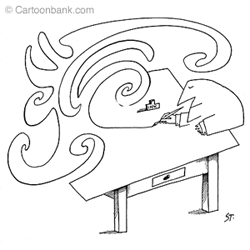 Born in Romania and educated in Bucharest and Milan (philosophy, literature and architecture), cartoonist and illustrator Saul Steinberg sold his first cartoon to The New Yorker in 1941 while he was waiting for his visa to enter the US. His witty, imaginative, uncannily perceptive and deceptively simple images appeared on the cover and in the pages of The New Yorker for nearly 60 years. Despite his successful gallery and museum exhibitions around the US and across Europe, Steinberg never stopped doing illustrations and cartoons for the magazine. He just loved the printed page and the printed page loved him back.
In a number of his drawings Steinberg made use of one of the conventions of comics: words coming out of people’s mouths, to brilliant effect, substituting lines, shapes, patterns and visual symbols for words, and giving us a graphic impression of speech and verbalization. (Here is a brief article that goes into more detail about that.) He also gave us wonderful graphic impressions of the sounds of different musical instruments. Many of his drawings (most, in fact) show a fascination with “line” itself. What is a line, where does that line go, and where (and how) do you draw the line? If Hirschfeld is “The Line King”, Steinberg is “The Line Mage”.
There is a Saul Steinberg Foundation devoted to the study of his work that includes a small gallery (I love the woman in the bathtub).
For a better overview of his work, there is a nice section about Steinberg, along with many images, on the New Yorker’s Cartoonbank site. Here a link to the covers. (I wrote about the Cartoonbank site in August of last year.)
There is a new book by Joel Smith: “Steinberg at the New Yorker”.


