


For years, The Sleeping Gypsy (above), a painting by French artist Henri Rousseau, was one of the most widely reproduced images in the world. (It may still be, I don’t know.) When I was in college I marveled at the number of apartment and dorm room walls it appeared on. My own apartment at the time had a copy of Rousseau’s Carnival Night (below, left) on a prominent wall and I spent a fair bit of time in front of the original in the Philadelphia Museum of Art.
A major exhibition of Rousseau’s jungle-themed paintings just closed a the Tate Gallery in London and his work is on prominent display in major museums around the world. Not bad for a self-taught “naive” artist who didn’t start painting seriously until he was 40.
Rousseau desparately wanted to paint like Bougereau or Gérôme, mainstream Academic Salon painters of his day. Fortunately for us, his own individualistic vision was stronger than that desire, and seemingly impervious to the influence of the impressionist style blooming around him, even though he associated with artists in that circle.
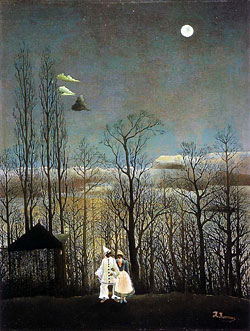 Loosely classed as a “Post-Impressionist”, Rousseau stands unique, almost outside the flow of art history. Yes, you can find influences if you look hard enough (Gauguin, for one), but his style doesn’t really “fit” anywhere. The Surrealists adopted him as a precursor to Surrealism, admiring the dream-like quality of his images and the vertiginous lack of formal perspective (which he never mastered, perhaps a moot point since it was being intentionally abandoned by modernist painters at the time). He got the attention of many of the avant-garde artists and writers of the day, including Degas, Renoir, Gauguin and Aplloinaire. Many of them joined in a banquet organized by Picasso in Rousseau’s honor two years before his death.
Critics ridiculed Rousseau as not a serious artist (as critics will, being such a broad-minded, egalitarian and generous group as a whole), and called him Le Douanier, “the customs inspector”, after his day-job of many years. (Of course these same people would probably have called Einstein “the patent clerk”.) Rousseau was from a family of modest means and couldn’t afford to go to art school. Admittedly, he was eccentric; he considered himself one of the greatest artists of the age, seemed unable to distinguish sarcastic remarks from sincere compliments and sometimes bragged of accomplishments that were untrue.
His paintings, though, speak undeniably of their own power. His fantastic images of intense jungles and wild beasts (based on books and visits to the botanical gardens, he never left France) resonate with us on some instinctual level. He not only developed his own artistic style, but his own unconventional methods of painting, applying the colors one at a time, painting in layers of content (sky first, then other background elements, finishing with foreground subjects) and working the canvas methodically from the top down.
Here is a good bio on the Artelino Art Auction site. Here is a nice site devoted to Rousseau and his work, but the color of the reproductions is off. There are Rousseau links on the Artcyclopedia site
The sites I link to below are image collections on the WebMuseum and the ARTchive (pop-up and ad warning for the latter).


