I sometimes think there is nothing so delightful as drawing.
-Vincent van Gogh
If people knew how hard I worked to get my mastery, it wouldn't seem so wonderful at all.
- Michelangelo Buonarroti


Thursday, February 2, 2006

William Holman-Hunt

Posted by Charley Parker at 9:14 am

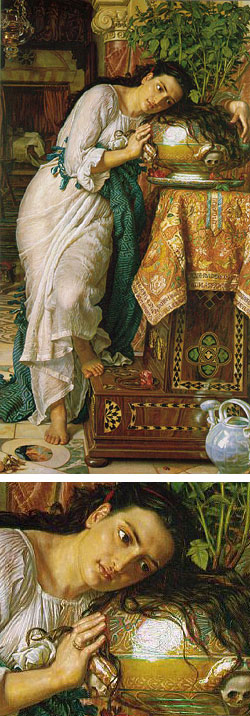
There are more dramatic images I could have chosen to represent Holman-Hunt, The Scapegoat, for example or The Hireling Shepherd, but this painting, Isabella and the Pot of Basil , has a personal connection for me because I’ve been visiting the original in the Delaware Art Museum since I was an adolescent.

The painting was personal for Holman-Hunt in a very different way. It was based on portraits of his first wife and painted shortly after her death. The rather macabre story it depicts is from a Renaissance poem in which Isabella discovers the body of Lorenzo, who her brothers have murdered because they want her to marry another. She severs his head and buries it in a pot of basil which she waters with her tears. Holman-Hunt also painted a larger version of the same composition, which is in the Laing Gallery in Newcastle, England.

The original painting is small (15×23″, 38×58cm) and has a gem-like quality when standing in front of it. It is rich with the extraordinary detail and luminescent color that make the Pre-Raphaelite works so appealing to many (except, of course, to art critics, who seem immune to visual pleasure). You can literally spend hours working your eye through Holman-Hunt’s paintings, luxuriating in the visual feast of his attention to the texture and color of physical objects.

The composition of this work seems oddly off-kilter, but Holman-Hunt was such a masterful painter that I have to assume that is intentional. I find myself leaning into the pot of Basil with isabella and perhaps feeling additionally unsettled as if sharing her disorienting grief.

Even though Holman-Hunt professed social and religious views that valued purity and piety and often portrayed religious subjects, his paintings seem to revel in the sensuality of the physical world; you want to run your hand across the polished wood, feel the embroidered fabrics with your fingers, smell the plants and be dazzled by the light that bathes objects in glowing warmth.

Holman-Hunt, along with Dante Gabriel Rosetti and John Everett Millais, who he met while they were students at the Royal Academy, was a founder of the Pre-Raphaelite Brotherhood. The Pre-Raphaelites were a group of English painters and writers who rejected the idealized academic painting of the day, as exemplified by Sir Joshua Reynolds, then head of the Royal Academy, and embraced a return to the rich color and detail of the early Renaissance (before Raphael and his contemporaries started their own kind of idealized painting).

They desired to be faithful to nature in their paintings an also infused them with romanticism, pulling their subject matter from Keats, Shakespeare and classical literature. They were aided by critic John Ruskin, one of the few art critics who actually seems to have made a contribution to the history of art, if only because he defended the Pre-Raphaelites against the harsh treatment they received from other critics (a practice that still seems necessary today.)

There is a good selection of Holman-Hunt’s paintings on the Art Renewal Center and the ARTchive (ad warning).

 
Share or bookmark this post:
  • Digg
  • del.icio.us
  • Facebook
  • Google Bookmarks
  • Mixx
  • Reddit
  • Sphinn
  • StumbleUpon
  • Yahoo! Bookmarks
  • Yahoo! Buzz
  • Twitter

4 comments for William Holman-Hunt »

RSS feed for comments on this post. TrackBack URI

  1. Comment by Jenny
    Monday, February 6, 2006 @ 8:38 pm

    Nice site! I’ll have to set aside time to read more of it properly. Good taste in stuff!

  2. Comment by Charley Parker
    Tuesday, February 7, 2006 @ 10:43 am

    Thanks, Jenny.

  3. Comment by Bob
    Wednesday, June 10, 2009 @ 10:14 am

    I admire the PRB and Holman-Hunt, but hadn’t noticed his apparent trouble using linear perspective until you pointed it out that the “composition of this work seems oddly off-kilter”.

    For Isabella, the background reads plumb. The forground furniture piece reads as two rectangular boxes that should have the same vanishing point, but don’t. Also, the right part of the upper box reads plumb, the left tilts to the right. This all makes Isabella’s location and pose seem anatomically impossible and makes the painting seem unreal.

    Another HH example of troubling use of linear perspective is the right-tilting walkway in The Importunate Neighbour and the unnecessarily intrusive and simplistic converging lines of perspective drawing in the wall and porch.

    Finally, The Awakening Conscience always seemed off-kilter to me. Now I see this partly explained in the conflicting clues to perspective in the lines of the piano, the “too-sloped” floor and puzzling perspective clues defined in the mirror.

    The composition of these paintings seem very elegant to me and not at all off-kilter, if one disregards 3D perspective. What’s off-kilter is coherently realistic representation of perspective.

    It is conceivable that HH might have subordinated accurate perspective to the service of composition, I suppose. I would tend to see it as simply not being able to keep all the balls in the air.

  4. Comment by Charley Parker
    Wednesday, June 10, 2009 @ 9:48 pm

    Thanks for your interesting comments, Bob. I hadn’t looked at HH’s other painting with that in mind, though the odd feeling in Isabella seems more related to simple parallels (or off-parallels) rather than complex perspective issues.

Leave a comment

(required)

(required but not published)


For best results, click on article title first, then translate.

Please note that display ads for lines and colors are limited to art related topics and may not be animated.
Exhibitions
Drawing, Illustration and Comics
Updated 9/13/09
Engines of Enchantment: the machines and cartoons of Rowland Emett
29 July - 1 Nov, 2009
The Cartoon Museum, London, UK
Illustrating Her World: Ellen Bernard Thompson Pyle
Aug 1, 2009 - Jan 3, 2010
Delaware Art Museum, DE
Intrepid and Inventive: Illustrations by Rockwell Kent
Sept 12 - Nov 19, 2009
Brandywine River Museum, DE
Renaissance to Revolution: French Drawings from the National Gallery of Art, 1500 - 1800
Oct 1, 2009 - Jan 31, 2010
National Gallery of Art, DC
Rococo and Revolution: Eighteenth-Century French Drawings
Oct 2, 2009 - Jan 3, 2010
Morgan Library and Museum, NY
Maxfield Parrish: Illustrated Letters
Oct 17, 2009 - Jan 17, 2010
Delaware Art Museum, DE
Fantasies and Fairy-Tales: Maxfield Parrish and the Art of the Print
Oct 31, 2009 - Jan 10, 2010
Delaware Art Museum, DE
Alice in Pictureland: Illustrations of Lewis Carroll's Classic Tales
Nov 27, 2009 - Jan 10, 2010
Brandywine River Museum, DE
The Drawings of Bronzino
Jan 20 - April 18, 2009
Metropolitan Museum of Art, NY


Donate Life

The Gift of a Lifetime