The important thing is to keep on drawing when you start to paint. Never graduate from drawing.
- John Sloan
A man should hear a little music, read a little poetry, and see a fine picture every day of his life.
- Johann Wolfgang von Goethe


Tuesday, April 18, 2006

Samuel Palmer

Posted by Charley Parker at 8:49 am

Samuel Palmer
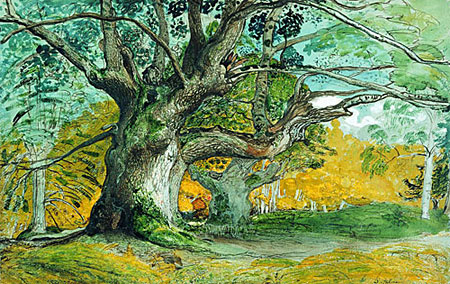
Artistic approaches to landscape can be as fascinatingly varied as landscape itself. The variety of style, material, color, medium and technique is amazing. Samuel Palmer’s landscape paintings in oil, watercolor, gouache, ink and sepia wash often have a unique character that feels like fantasy or children’s book illustration, particularly work from a period when he was heavily influenced by the Romantic artist/poet William Blake.

Palmer met Blake through English landscape artist John Linnell, who was something of a mentor to him and whose daughter, Hannah, became Palmer’s wife. Palmer’s own family was less than an asset. His father had an unfavorable reputation and a poor economic situation, putting pressure on his sons to restore the family name. One of Palmer’s brothers, finding himself without funds while Palmer was away on his two-year honeymoon/painting expedition to Italy, pawned most of Palmer’s early work and Palmer had to pay out a great deal to get it back. Palmer’s son, Herbert Palmer, apparently burned large amounts of his father’s work after his death, ostensibly so it would not be disrespected (and you think you have family troubles as an artist).

Palmer never saw great commercial success as a painter and most of his income came from teaching drawing, at which he was apparently quite good. Palmer’s work fell into semi-obscurity for many years and has only recently been re-discovered by the art world.

In 2005 the British Museum and the Metropolitan Museum of Art cooperated to create the first major retrospective exhibition of Palmer’s work, Samuel Palmer: vision and landscape, which helped re-establish him as one of the most important landscape painters of his era. It ran at the British Museum from October 2005 to January of this year and is currently running at the Met until May 29, 2006. The British Museum site still has the section devoted to the exhibition online here. The Met’s section is here. Both have examples of Palmer’s work in several mediums.

“Success” is almost as subjective a concept as “style”. Midway through his career, Samuel Palmer consciously changed his style to a more traditional landscape approach in a failed attempt to make his work more salable, but it is for his visionary Romantic work that he is remembered and revered. He may not have found any greater financial success had he remained true to his original vision, but would he perhaps have found a greater level of personal success? All artists have to find their own meaning for that word, but I think Palmer’s success was in creating unique landscape images that we still find engaging and visually rewarding after 200 years.

Share or bookmark this post:
  • Digg
  • del.icio.us
  • Facebook
  • Google Bookmarks
  • Mixx
  • Reddit
  • Sphinn
  • StumbleUpon
  • Yahoo! Bookmarks
  • Yahoo! Buzz
  • Twitter

4 comments for Samuel Palmer »

RSS feed for comments on this post.

  1. Comment by clive
    Tuesday, April 18, 2006 @ 5:29 pm

    Lovely to see the Palmer. Have been really enjoying and learning from this site for months now; well written, gregarious and knowledgable. I’m not nearly so knowledgable, which is why I enjoy it so much. Perhaps I’m mistaken, but when looking at 19th century British watercolourists, particularly the early part, I often think how ‘ahead of their time’ they might be considered, ‘feeling’ like stuff that was done in oil on the continent decades later. Not that it matters though, it’s not a race. But I do think a lot of those great watercolourists often get overlooked. But not by you… Best, C.

  2. Comment by Charley Parker
    Tuesday, April 18, 2006 @ 10:49 pm

    clive,

    Thanks for the good words about the blog. Glad you’re enjoying it.

    Watercolor was long considered a “preliminary” medium, like drawing – good for preliminary studies and sketches but not suitable for finished works – and watercolorists had to fight for acceptance and respectablilty in salons and among patrons. But watercolor has its own character and invites a certain degree of experimentation, so styles may have evolved in watercolor that didn’t influence works in oil until they had time to filter through the levels of art society strata over time. I don’t actually know – just guessing.

  3. Comment by smacleod
    Thursday, April 20, 2006 @ 2:43 pm

    just beautiful!

  4. Comment by Davin Palmer
    Tuesday, December 8, 2009 @ 4:23 pm

    I have a great,great grandfather with the same name. Sometimes I wonder..Does anybody know the painters birth and death dates?

Leave a comment

(required)

(required but not published)

 
Display Ads on Lines and Colors: $25/week or $75/month.

Please note that display ads for lines and colors are limited to art related topics and may not be animated.


Donate Life

The Gift of a Lifetime
Exhibitions
Drawing, Illustration and Comics
Updated 5/18/10
Norman Rockwell: Behind the Camera
Nov 7, 2009 - May 31, 2010
Norman Rockwell Museum, MA
Drawings and Prints: Selections from the Permanant Collection
April 21 - July 4, 2010
Metropolitan Museum of Art, NY
An Italian Journey: Drawings from the Tobey Collection, Correggio to Tiepolo
May 12 - Aug 15, 2010
Metropolitan Museum of Art, NY
Defining Beauty: Albrecht Dürer at the Morgan
May 14 - Sept 12, 2010
Morgan Library and Museum, NY
Batman: Yesterday and Tomorrow
Jan 30 - June 6, 2010
Cartoon Art Museum, CA
The Pastoral Vision:British Prints, 1800 — Present
May 15 - Aug 15, 2010
Delaware Art Museum, DE
Earth: Fragile Planet
June 4 - July 31, 2010
Society of Illustrators, NY
German Drawings from the Wolfgang Ratjen Collection, 1580 to 1900
May 16 - Nov 28, 2010
National Gallery of Art, DC