Those who are not conversant in works of art are often surprised at the high value set by connoisseurs on drawings which appear careless, and in every respect unfinished; but they are truly valuable... they give the idea of a whole.
- Sir Joshua Reynolds
We do not see things as they are,
we see them as we are.
- Anais Nin


Monday, May 29, 2006

Frederick Lord Leighton

Posted by Charley Parker at 11:22 pm

Frederick Lord Leighton
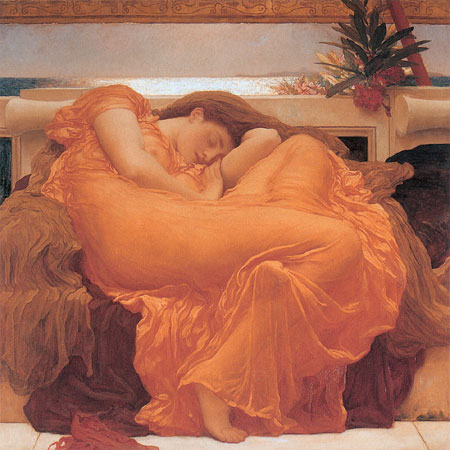
Frederick Lord Leighton (not to be confused with Edmund Blair Leighton, who I profiled last week), was one of the most influential of all Victorian Academic painters.

He was very much within the academic neoclassical tradition, in contrast to the painters of that time who were favored in retrospect by the 20th century art establishment, and were remembered primarily for their rejection of that tradition. For much of the 20th Century, art historians and critics considered rejection of 19th Century Academic art a badge of honor, because Academic art was the “bad”, “repressive” art from which the modern art movements “liberated” us.

I’ll resist going into a big rant about what a poisonous attitude this overt rejection of tradition by the modernist establishment was. I like a lot of modern painting, but I have nothing good to say about the concerted campaign the modernists waged to discredit figurative art when they came to dominate the art establishment. I’ll just say that I enjoy Academic art and, in spite of the formality and absence of emotion in much neoclassical painting, I would rather spend my time in front of one of Leighton’s beautifully executed canvasses than a museum full of late 20th Century “isms”, which were bred from another kind of formality and dearth of emotion. (OK, so I did rant, but it wasn’t a big rant.)

Leighton was closely tied to the Royal Academy, exhibited most of his major works there and was elected its president in 1878. He painted with the emphasis on draughtsmanship and elegant rendering that was fundamental to the neoclassical style, and his subject matter was mostly scenes from ancient history, mythology or the Bible. Unlike some of the weaker Academic painters who got caught up in the mere visual reconstruction of those times or subjects, Leighton was faithful to the original vision of neo-classical art and the pursuit of timeless beauty.

Leighton’s early work was influenced by the Pre-Raphaelites and he shared their literary subject matter, painting scenes from Shakespeare and Dante, but he moved into more classical subjects as he travelled and was exposed to contemporary French and Italian Classical art.

As a mature artist, Leighton was so influential among Victorian Classical painters that Edward Burne-Jones, himself one of the great figures of Victorian art, nicknamed him “Jupiter Olympus”.

Posted in: Gallery and Museum Art   |  

9 comments for Frederick Lord Leighton »

RSS feed for comments on this post.

  1. Comment by Darren Reece
    Tuesday, May 30, 2006 @ 4:10 am

    The British painters of that time were a great counterpoint to the impressionist/post-impressionist developments on the continent. They also manage to avoid the subtle ridicule that plagues the legacy of late 19th Century French establishment artists such as Bouguereau.

  2. Comment by Jon Conkey
    Tuesday, May 30, 2006 @ 12:26 pm

    I think a lot about this time period, it was a very rich time in so many ways. The world thirsts for work like this today. Though true, modern art may inspire, but these painters showed us the heights that one may achieve when very particular skills are obtained through extreme discipline, devotion, and study. To put in a more simple way; I do not feel as “moved” standing in front of a Peter Max, as I do when standing in front of a Frederick Lord Leighton. JLC

  3. Comment by Jon Conkey
    Tuesday, May 30, 2006 @ 12:27 pm

    My apologies to Peter Max. JLC

  4. Comment by Charley Parker
    Sunday, June 4, 2006 @ 11:06 am

    Darren, Thanks for your comments. Yes, although I like the French Academic painters as well and I’m aware of the criticisms often leveled at all of the Academic artists for formality, lack of emotion and so on. The British Neoclassical painters always seemed to be pushing forward and exploring even within the confines of the Academic restrictions.

    Other readers may want to check out Darren’s intriguing drawings on his Faint Marks blog.

  5. Comment by Charley Parker
    Sunday, June 4, 2006 @ 11:13 am

    Jon, I agree, this is a particularly rich and underappreciated time in the histroy of art, usually overshadowed by the attention paid to impressionism and the birth of modernism.

    I happen to enjoy Peter Max, his stuff is just fun, but I also agree in that I could spend much more time with Leighton.

  6. Comment by joe boyle
    Wednesday, August 23, 2006 @ 5:23 pm

    Victorian “academic” painting, British or French, is one of the great achievements of Western Civilization. The technical expertise of Bouguereau,Alma-Tadema, Leighton, et al, is amazing. For me, NO artist who has not mastered anatomy and perspective is worth viewing. I’d love to see examples of the technical skills of some “abstract” painters..until I do, I consider abstraction to be the refuge of the unskilled.
    Incidentally, Leighton was also a formidable sculptor.

  7. Comment by Charley Parker
    Friday, August 25, 2006 @ 10:18 am

    Joe,

    I’m not familiar with Leighton’s sculpture. I’ll have to look into that. Thanks.

  8. Comment by Jean
    Friday, January 18, 2008 @ 3:32 pm

    Hi, I would like to know about what value 2 small Lord Frederic Leighton oil studies are valued at.

  9. Comment by Michelle
    Saturday, March 8, 2008 @ 6:00 pm

    Can you tell me if Lord Leighton or any of his family had any connection with Liverpool. Was he married and did he have any children

Leave a comment

(required)

(required but not published)


For best results, click on article title first, then translate.

Please note that display ads for lines and colors are limited to art related topics and may not be animated.
Exhibitions
Drawing, Illustration, Comics
Max Ernst: Illustrated Books
March 2 - Sept 6, 2008
Natioinal Gallery of Art (U.S.), DC
Medieval to Modern: Recent Acquisitions of Drawings, Prints and Illustrated Books
May 4 - Nov 2, 2008
Natioinal Gallery of Art, DC, USA
Raw Nerve! The Political Art of Steve Brodner
June 7- Oct 26, 2008
Norman Rockwell Museum, MA
Tiepolo Drawings from the Robert Lehman Collection
To August 17, 2008
Metropolitan Museum of Art, NY
Drawings and Prints: Selections from the Permanent Collection
To Oct 19, 2008
Metropolitan Museum of Art, NY
Double Lives: American Painters as Illustrators, 1850-1950
Sept 6 - Nov 23, 2008
Brandywine River Museum, DE
Frank E. Schoonover: An Artist for All Seasons
Nov 22, 2008 - Jan 11, 2009
Delaware Art Museum, DE


Donate Life

The Gift of a Lifetime