A line is a dot that went for a walk.
- Paul Klee
You can't depend on your eyes if your imagination is out of focus.
- Mark Twain


Tuesday, July 11, 2006

Hergé (Georges Remi)

Posted by Charley Parker at 11:42 am

Herge
You will occasionally hear me rant about the misuse of the term “graphic novel” in reference to trade paperback collections of comic books in America. (Watchmen is a graphic novel, Akira is a graphic novel. The last six issues of The Uncanny X-Men collected into a squarebound paperback isn’t any kind of a novel. It may be a graphic album, a collection or, if you’re lucky, a graphic story, but a novel it’s not.)

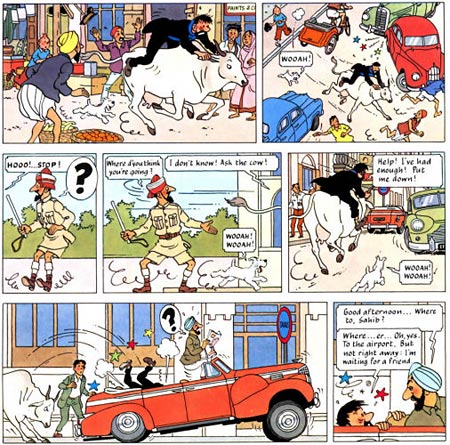
Belgian comics creator Hergé (a pen-name based on the French pronunciation of “RG”, Georges Remi’s initials in reverse) was a pioneer and master of the long form comics story, i.e. graphic novel. Though he created a number of characters and features, his major work is a series of stories of The Adventures of Tintin, which began in 1929.

Tintin is as familiar in Europe as Superman or Mickey Mouse is in America and is one of the most popular European comics of the last century. Basically a super-adventurous boy scout whose travels spanned the globe rather than the local woods, Tintin along with his dog, Snowy (Milou, originally) and his companion Captain Haddock, fascinated readers through a series of adventures to places like Russia, China, America (an exotic place to someone in France), India and fictional countries in the Balkans, South America and South East Asia.

His stories, while primarily adventures peppered with humor, carried echoes of the political and social world at the time, some of which were naive and kind of silly in their treatment of non-European races and cultures, and some of which, as time went on and Hergé matured, were astute and sensitive to the appreciation of other cultures, particularly China.

Hergé’s ligne claire, or “clear line”, style has been tremendously influential on European and Japanese comics artists and American newspaper comics artists from the early and mid 20th Century. His characters are simply and effectively drawn, while his backgrounds occasionally are quite detailed and often reflect careful research into real places and landmarks.

His stories have been translated into dozens of languages and if you scope around the net, you’ll find a great deal of Hergé and Tintin material, toys, posters, fan sites and webrings as well as mention of the Tintin movies and stage plays.

Hergé created 24 Tintin stories, the last one of which was left incomplete on his death in 1983. My favorite of them is Tintin in Tibet, in which Tintin’s unrelenting search for his Chinese friend Chang is an echo of Hergé’s own lost contact with his good friend of the same name during the Second World War.

The PBS program POV is due to air a story on Tintin called Tintin and I tonight (Tuedsay, July 11) at 10pm. (It’s certain to be repeated.)

There are wonderfully inexpensive albums of the Tintin stories available on Amazon or in most bookstores and comic stores worth their salt.

Tintin.com gives a nice, colorful overview of the characters and stories. Discover Tintin is a good fan site. Tintinologist.org is a kind of central point for links to other Tintin resources.

Posted in: Comics   |  

6 comments for Hergé (Georges Remi) »

RSS feed for comments on this post.

  1. Comment by Faz Choudhury
    Wednesday, July 12, 2006 @ 6:30 am

    I love Hergé’s work, Tintin in Tibet is a great book and has a strong emotional impact compared to the other books. My personal favourite is The Castafiore Emerald. It’s the one book where they don’t go anywhere and don’t really have an adventure, the mystery element isn’t even a mystery, it’s just a macguffin to have fun with the characters, it’s much closer to a sitcom. Some funny, funny moments, including the bit where Prof Calculus demonstrates his invention - the colour TV.

    You know you’ve got a good bunch of characters when you can stick them in a small space together and just let them interact so well. Beautiful, lovely work but then I’m a bit of a sucker for the ligne claire style.

  2. Comment by gabriel
    Sunday, October 15, 2006 @ 12:46 am

    I believe you made a mistake when saying “linge claire”. It’s actually “ligne claire” “linge” means clothes, not line. I know this seams useless, but who cares
    i’ve already written it, and am to busy (lazy) to press backspace.

  3. Comment by Charley Parker
    Sunday, October 15, 2006 @ 12:01 pm

    gabriel,

    Actually, I appreciate the help in keeping my tpyos typos under control. Thanks!

  4. Comment by Man Arenas
    Friday, May 11, 2007 @ 10:51 am

    In my Opinion, Hergé is one of the 5 geniuses graphic novel Art have.
    (along with Mc Cay, Eisner, Foster and Herrimann)
    This master teach my generation everything an want-to-be-auteur should know (I born luckily in Belgium)… and his art will everlast, every page he created reach such a perfection on narration and on the esence of graphism.
    The term “comic” is too reductive to humor and superheroes tales for europeans, that’s why we prefer the name “Bande dessinée” “graphic strip” , we tell a story with drawings therefor the “Roman/Nouvelle Graphique” > Graphic Novel.
    by the way, Hergé and some other artists of his style were the only artists teach already in school when I was still a kid.
    On top of all this, Tintin stories have an amazing sense of intelligent humor.
    .-)

  5. Comment by Charley Parker
    Saturday, May 12, 2007 @ 10:46 am

    Thanks for the comments, Man. I agree, Hergé is one of the greats. Yes, “comics” is an awkward term. Yes “bande dessinée”, graphic strip, or literally “strip of drawings”is a broader and more flexible term. But things are changing here. We’re already seeing move toward the European style of graphic album, and the image of comics as being just for kids is definitely changing.

    Other readers who have not seen my previous post on Man Arenas (Dodecaden), should check out his terrific concept art.

  6. Comment by MOHAMMED AINOOSON
    Sunday, April 6, 2008 @ 11:10 am

    PLEASE MASTER HERGE CAN I GET A STORY OF TINTIN AND GUMMY BEARS.

Leave a comment

(required)

(required but not published)


For best results, click on article title first, then translate.

Please note that display ads for lines and colors are limited to art related topics and may not be animated.
Exhibitions
Drawing, Illustration, Comics
Things That Go Bump
Oct 13, 2007 - March 17, 2008
The Museum of Comic and Cartoon Art, NY
Drawing: A Broader Definition
Oct 27, 2007 - May 4, 2008
Museum of Fine Arts, Boston, MA
The baroque Woodcut
Oct 28, 2007 - March 30, 2008
National Gallery of Art, D.C.
LitGraphic: The World of the Graphic Novel
Nov 10, 2007 - May 26, 2008
Norman Rockwell Museum, CT
National Geographic: The Art of Exploration
Jan 27 - May 25, 2008
Allentown Art Museum, PA
Rhythms of Modern Life: British Prints 1914-1939
Jan 30 - June 1, 2008
Museum of Fine Arts, Boston, MA
Sex and Sensibility: Ten Women Examine the Lunacy of Modern Love in 200 Cartoons
Feb 9 - June 8, 2008
The Cartoon Art Museum, CA
Elihu Vedder and The Rubáiyát of Omar Khayyám
March 15 - May 18, 2008
Brandywine River Museum, PA
Utagawa: Masters of the Japanese Print
March 21 - June 15, 2008
Brooklyn Museum, NY


Donate Life

The Gift of a Lifetime