An ordinary artist shows you the things everybody can see. The egotistical artist shows you the things only he can see. But the great artist shows you things nobody ever saw before.
- Pablo Picasso
Failing is not a problem.
Not trying is a problem.
- Jay Maisel


Monday, September 11, 2006

Pencils!

Posted by Charley Parker at 8:59 am

Pencils
It’s often said that the greatest joy comes from the simplest things.

In these days of gel pens, precision markers, synthetic brushes, high-tech plastic paints and digital painting software, it’s easy to overlook the humble pencil, which was actually something of a technological marvel itself at one time.

Pencils were created after the first major deposit of pure solid graphite was discovered in England sometime in the 1500’s. The graphite was first thought to be coal (which it technically is), and then, because it didn’t burn easily, mistakenly thought to be a form of lead. It was initially used for medicinal purposes and then to line cannonball molds; and for a while its use for anything else was strictly controlled and export forbidden (war before art, as always).

It was soon realized that the new substance (which, like diamond, is an allotrope of carbon created under high pressure and heat) was useful for making marks, hence the name graphite.

The first graphite pencils (from the latin pencillus, “little tail”) were made in Keswick, England by wrapping rough pieces of the graphite in sheepskin. One of the early uses, in fact, was for marking sheep there in the countryside where the graphite was discovered.

It was the Italians who first encased the graphite in wooden holders (the modern form of which uses incense cedar), and Dutch traders who spread the new drawing instruments to artists throughout Europe.

In 1795, during the Napoleonic wars when English pencils were not available to the French, Nicholas Conté, an officer in the French army, discovered that mixing amorphous (powdered) graphite with fine clay and firing the mixture in a furnace could produce a substitute for the rare solid form from the original English deposit, (which was the only such deposit known and would eventually run out in 1890).

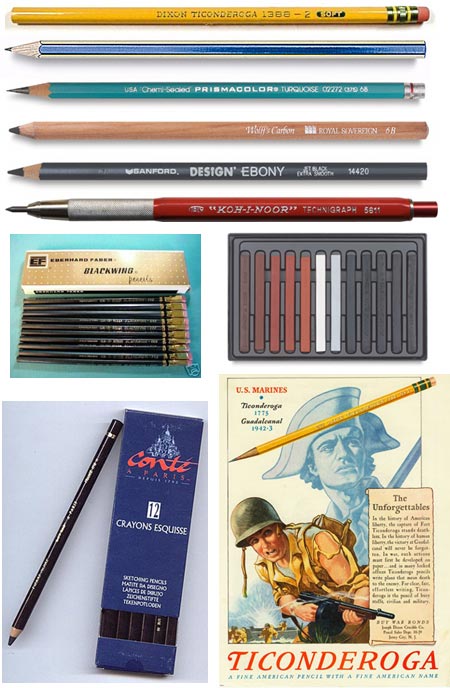
In addition, Conté realized that altering the proportions of the clay to graphite mixture produced varying degrees of hardness. Conté originally pressed the graphite and clay mixture into sticks, called Conté Crayons, setting them apart from other drawing and writing crayons, which were chalks; and the mixture itself was called Conté. Modern Conté Crayons (image above, middle right) ironically are refined versions of chalk crayons.

Eventually Conté’s mixtures were encased in wood, as with the Engilsh solid form of graphite, thus producing the modern pencil as we know it today.

Pencils have had a colorful history in the social, political and scientific realms as well as in art. In recent times, famous pencil brands and models have come and gone with great devotion from artists and writers alike, from the legendary Eberhard Faber Blackwing 602 (a favorite writing tool of John Steinbeck and Tom Wolfe, also loved by artists, now discontinued and selling on eBay for up to $20 each), to the Sanford Design Ebony Pencil (smooooth), to the good old Dixon Ticonderoga (inexpensive and great).

There are all manner of mechanical pencils too, of course. One of my favorite forms of pencils for drawing is the 2mm leadholder, or drafting pencil (red Koh-I-Noor model shown above), which I wrote about in this post and is a favorite among professional comic book artists.

There are some good books on pencil drawing. Some of them are unfortunately out of print classics, but still available: The Art of Pencil Drawing by Ernest W. Watson, and my personal favorites (but perhaps a bit dated looking for some) Rendering in Pencil and Pencil Drawing Step by Step by Arthur L. Guptill. (Together they are the Watson and Guptill of Watson-Guptill art book publishers.)

Below are a number of links to pencil related sites and blogs from my bookmarks; particularly note The Pencil Pages, a large site with lots of pencil info that includes reproductions of classic pencil advertisements (above, right), and the Pencil Revolution blog, which is devoted to increasing appreciation of this humble marvel of drawing technology.

Posted in: Drawing, Tools and Techniques   |  

9 comments for Pencils! »

RSS feed for comments on this post.

  1. Comment by Arne
    Monday, September 11, 2006 @ 4:56 pm

    News flash. The biggest pencil bummer ever: Karisma pencils were bought out of business, and replaced by prismacolor.
    Karisma pencils were the best quality colored pencils ever, prismacolors are cheap replica’s that don’t do the job. I depend on karisma for my job. So now the question is: Does anybody still offer them?

  2. Comment by ParisBreakfasts
    Tuesday, September 12, 2006 @ 11:16 am

    YUM..wonderful post on the beloved pencil, our first drawing friend. Thank you. Although I don’t see my all time favorite and most addicted to pencil, the lowly Yellow PAPERMATE Sharpwriter #2. Granted the eraser is dreadful and must be replaced but it makes a lovely drawing pencil…I couldn’t live with it. I better rush out and get some more in case it gets bought out…

  3. Comment by ParisBreakfasts
    Tuesday, September 12, 2006 @ 1:27 pm

    P.S.
    Here’s a painter in New Zealand who seems to be obsessed with painting pencils…they are quite an homage IMO
    http://postcardfrompuniho.blogspot.com/2006/09/pencil-stub.html

  4. Comment by Alice
    Tuesday, September 12, 2006 @ 9:08 pm

    My husband Chris sent me to this site. The joke around our house is that I can’t use a pencil without smelling it first…during, after. Not true, unless it is a Dixon Ticonderoga. Who could pass up a sniff? They smell like the first day of school, like anticipation. Quick, give me something to write!!
    Don’t bother smelling the cheap pencils. You’ll be disappointed.

  5. Comment by Charley Parker
    Saturday, September 23, 2006 @ 12:49 pm

    Arne,

    If you don’t get a reply hrere, you may want to go to the Pencil Revolution blog mentioned above and ask there.

  6. Comment by Charley Parker
    Saturday, September 23, 2006 @ 12:51 pm

    ParisBreakfasts,

    Thanks. I’ve actually written about Paul’s work in my “Painting a Day” posts, but I didn’t catch the frequency of his pencil paintings.

  7. Comment by Charley Parker
    Saturday, September 23, 2006 @ 12:52 pm

    Alice,

    I agree. It’s the incense cedar. Love the smell of kneaded erasers too.

  8. Comment by Beek
    Monday, December 17, 2007 @ 5:01 am

    Derwent Pencils will always be the best. Their Coloursoft range is a perfect replacement to Karisma

  9. Comment by aya
    Wednesday, November 12, 2008 @ 10:21 am

    im working on my o-level art exam and im using karisma colored pencils and they are amazing but i was wondering were i could get some in dubai??…..
    seeking help :-)

Leave a comment

(required)

(required but not published)


News:

Exhibition list updated November 11 (lower in this column)


For best results, click on article title first, then translate.

Please note that display ads for lines and colors are limited to art related topics and may not be animated.
Exhibitions
Drawing, Illustration and Comics
Updated 11/11/08
Double Lives: American Painters as Illustrators, 1850-1950
Sept 6 - Nov 23, 2008
Brandywine River Museum, DE
The Totoro Forest Project
Sep 20, 2008 - Feb 8, 2009
Cartoon Art Museum San Francisco, CA
A Light TOuch: Exploring Humor in Drawing
Sep 23 - Dec 7, 2008
The Getty Center, CA
New Acquisitions
Oct 7 - Dec 31, 2008
Society of Illustrators, NY
Drawings and Prints: Selections from the Permanent Collection
Oct 20, 2008 - Jan 11, 2009
Metropolitan Museum of Art, NY
Giles: One of the Family
Nov 5, 2008 - Feb 15, 2009
The Cartoon Museum, London, UK
Over the Top: American Posters from World War I
Nov 8, 2008 - Jan 25, 2009
Norman Rockwell Museum, MA
Leonardo da Vinci: Drawings from the Biblioteca Reale in Turin
Nov 15, 2008 - Jan 4, 2009
Fine Arts Museum of San Francisco, CA
Frank E. Schoonover: An Artist for All Seasons
Nov 22, 2008 - Jan 11, 2009
Delaware Art Museum, DE


Donate Life

The Gift of a Lifetime