


 Writers, and often the public, like to romanticize the connection between madness and art. From the emotional anguish of van Gogh to the physical violence of Caravaggio, there is a notion of the artist going to the brink, and over, and returning with visions from the other side that would be inaccessible to the normal mind.
Whether this is true is a matter of debate, and mental illness is hardly romantic, though in the case of Victorian Painter Richard Dadd, his most memorable works of ramantic fantasy were produced after he was committed to “Bedlam” (Bethlem Hospital) because of violent insanity.
Dadd descended into a state we would now call paranoid schizophrenia during a trip to Egypt and the middle east. After his return, he murdered his father, who he evidently believed was possessed by the devil, and fled to Paris, where he was arrested for assaulting another traveler, who he also perceived as possessed. Evidently there was a genetic predisposition to mental illness in his family.
Dadd was a painter whose images of fairies and other subjects from folklore and fantasy are part of a larger stylistic branch of Victorian painting dealing with these subjects, sometimes simply called the “Fairy School”. His pre-commitment paintings of the subject were open and airy; those created afterwards, for which he is most noted, are quite different, large scale, flattened in perspective and richly (or obsessively) detailed.
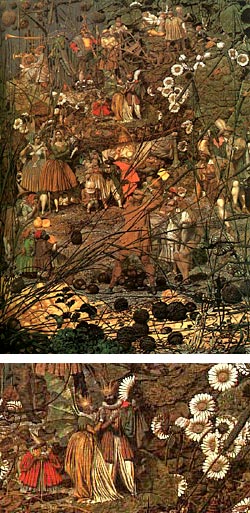
Fairy Feller’s Master-Stroke, shown here, is his most recognized work. Dadd worked on it for nine years and still considered it unfinished. He finally did stop working on it, however, and then produced a copy in watercolor (the original is in oil) and wrote a strange “guidebook” for the painting in verse.
It’s difficult to get any feeling for this painting from the tiny image here. There is a large version here, another large one here and a larger one here, that is unfortunately a bit dark.


Low resolution web versions still don’t convey the detail in the image, though. If you are interested you really should look for a reproduction in print. The one I have is in Victorian Painting by Lionel Lambourne (an excellent book, BTW). There are also books devoted to Dadd’s work. The World of Richard Dadd by Michael Mott is inexpensive and serves as a nice introduction.
By all accounts, though, you really can’t grasp this painting, which is in the Tate Gallery in London, until you see it in person (I haven’t), because of the dramatically three-dimensional nature of the application of the paint.
Dadd did many other paintings during the time he spent in the hospitals, and his work has been influential on fantasy painters from his own time through the present.