Opportunity is missed by most people because it is dressed in overalls and looks like work.
- Thomas Edison
A thimbleful of red is redder than a bucketful.
- Henri Matisse


Saturday, February 3, 2007

Jan van Eyck

Posted by Charley Parker at 12:00 pm

Jan van Eyck15th Century painter Jan van Eyck was the first great master of oil painting, though he was not, as was commonly believed, the originator of the practice of oil painting.

When oil based paint was first formulated it was used for practical or craft-like applications on objects, because it was more durable in that role than the (usually egg-based) tempera paint traditionally used by artists during the middle ages. (By durable, I mean resistant to abrasion, there are extant examples of tempera paintings that are almost 2000 years old.)

Tempera dries very quickly and is often applied in quick, thin layers, or small cross-hatch strokes. The ability of the medium to carry pigment is limited, as a result so is the saturation of color. Oil paint is fundamentally different. It dries much more slowly, and the qualities of linseed oil that allow it to hold the pigment suspended in beautiful transparent layers gave artists like van Eyck the freedom to create smooth blended tones and luxuriously layered glazes, saturated with vibrant color.

Van Eyck must have been the special effects genius of his day, dazzling anyone who encountered his work with a virtuoso display of the capabilities of this remarkable painting medium, along with the ability it gave him to create works that were painted with astonishing levels of realism and an almost insane degree of detail.

Figurative painting in some respects grew out of a tradition of decorating objects. In medieval painting in particular there is a tendency to treat the painting as both an image and a decorative object, filled with elaborate details of decorative elements. Van Eyck is a central point where this tradition meets the beginning of the more image-centric traditions of the Renaissance and the results are an uncanny mix of realism and detail.

I have often stood in the Philadelphia Museum of Art, magnifying glass in hand, marveling at the incredibly fine details in the foreground objects and background scene in van Eyck’s St Francis of Assisi Receiving the Stigmata. If you see this painting in reproductions, you assume it must be bigger than its actual size of 5 x 5¾” (12.7 x 14.6 cm).

For all his uncanny realism, van Eyck still displays (at least to my eye) some of the primitivism of medieval painting in the form of lapses in perspective and proportion. His figures’ hands, for example, often seem flattened and disproportionately small. Perspective sometimes seems off in his super-detailed backgrounds, but his display of painting virtuosity and the astonishing levels of detail make you forgive him almost anything.

Take a look at his larger work, The Virgin and Child with Nicolas Rolin, and a detail from the background of the same painting. (it was common for the powerful patrons who commissioned paintings at the time to have themselves portrayed cozying up with saints and other religious figures.) Van Eyck’s truly large works, like the famous Ghent Altarpiece, must have taken people’s breath away and seemed like miracles in and of themselves.

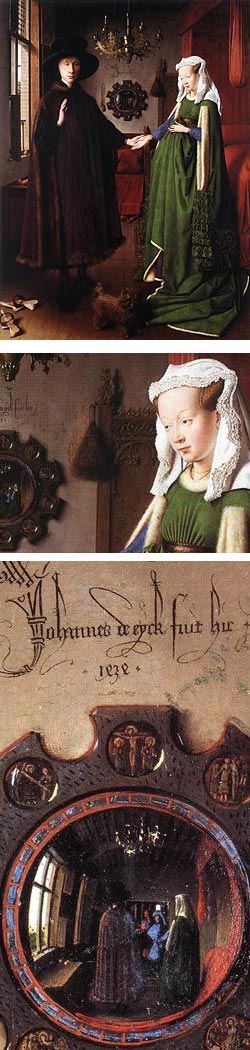
The painting shown here, Portrait of Giovanni Arnolfini and his Wife is also filled with detail. Images like this were also charged with symbolism. Almost everything in the painting, from the formal arrangement of the couple, their dress, hand positions, the shoes, the carpet, the oranges on the windowsill, means something. For a more elaborate and scholarly interpretation than I can possibly go into here, see Craig Harrison’s Jan Van Eyck, The Play of Realism. (There is also a teen-novel based around this painting, The Wedding: An Encounter with Jan van Eyck by Elizabet Rees.)

There are other interesting things about this work in particular, notably in the question of who is “here” in the scene. The couple seem unaware of us as observers, but the dog at their feet is looking directly at us (perhaps imbued with an uncanny 6th sense that allows him to know he is being watched by observers from another time).

Among the fascinating details in the room is a convex mirror on the wall behind, and between, the couple. In the reflection in the mirror we can see, past the backs of the main figures, two more individuals, one in red, the other in blue, who are witnesses to the scene (and presumably the actual subject of the dog’s attention). The mystery figures are, in fact, standing where they would have our view of the scene and we, as observers of the painting, are taking their place in the room.

There is also a gargoyle, part of the furniture in the background, but positioned as if sitting on the joined hands of the couple. (There are no accidents here.)

The mirror is flanked by a whisk broom on one side and a set of glass prayer beads on the other. Above it is a date (1434) and the artist’s signature. Van Eyck was the only Northern painter of his day to sign his work, but even then the signature was usually subdued, or perhaps even part of the frame.

Here, indicating that van Eyck was somehow more personally involved in this image than others, it is painted as if inscribed on the wall itself, like some elaborately penned example of 15th Century graffiti. The inscription is Latin for “Jan van Eyck was here.”

Indeed he was.

 
Share or bookmark this post:
  • Digg
  • del.icio.us
  • Facebook
  • Google Bookmarks
  • Mixx
  • Reddit
  • Sphinn
  • StumbleUpon
  • Yahoo! Bookmarks
  • Yahoo! Buzz
  • Twitter

10 comments for Jan van Eyck »

RSS feed for comments on this post.

  1. Comment by Nita
    Saturday, February 3, 2007 @ 12:19 pm

    Great blog, Charley. This is one I’ll send my readers to. Thanks.

  2. Comment by fermenta
    Saturday, February 3, 2007 @ 2:18 pm

    I’ve been following your blog for months and I have to say that I find it fascinating. I enjoy reading every post because it talks about painters or art pieces or whatever in such an ‘easy’ way. I don’t know exactly how to explain it. I mean it is accurate enough but also personal and very attractive to keep on reading.

    Anyway, an excellent blog.

    salud!

  3. Comment by Detlef
    Saturday, February 3, 2007 @ 5:02 pm

    Agree, great blog and I have been lurking for a while. David Hockney in his book Secret Knowledge uses van Eyck (and others) to demonstrate his theory that the quantum leap in realism could only have occurred through the use of optical aids. Likewise he goes on to say that these aids, and their distortionary qualities at the lens/projection margins resulted in some warped perspective.

    Again, great blog.

  4. Comment by Charley Parker
    Sunday, February 4, 2007 @ 11:56 am

    Thanks. I appreciate the comments, and it matters to me that people are enjoying the posts. I do try to keep a balance between being informative and remaining casual and personal, so it’s nice to know it’s appreciated.

    Detlef, thanks for the mention of Hockney’s book. I’m not familiar with it, but it sounds worthwhile. Somewhere on my list is the intention of doing posts on some of the various drawing, sighting and scaling aids that artists have used over the years.

  5. Comment by Dale Stephanos
    Monday, February 5, 2007 @ 2:48 pm

    Charley, ditto on the comments above. I’ve made your blog one of my regular stops every morning and it’s always worth the trip. I hope you don’t mind, but I’ve also swiped a post idea or two for my blog(always attributing yours though). Please keep up the great work.

  6. Comment by Katherine Tyrrell
    Wednesday, February 7, 2007 @ 12:55 pm

    Charley – it’s woth taking a look at some of Hockney’s Camera Lucida drawings if you get the chance as they clearly demonstrate the impact on perspective of using a lens as a drawing aid – particularly , http://www.thelamp.ca/books/index.php?id=16, his series of drawings of the guards at the National Gallery in London.

    The other thing I find curious about the use of the word ‘realism’ in relation to painters like Van Eyck is that the eye, is incapable of seeing that level of detail. True realism would in fact blur some of the ‘detail’ depending on where the focus is.

    My favourite Jan van Eyck is “Portrait of a Man with a turban” – and had always thought it much bigger than it actually is until I saw it ‘in the flesh’ as it were for the first time.

  7. Comment by Katherine Tyrrell
    Wednesday, February 7, 2007 @ 12:58 pm

    Whoops messed up the link – or does your blog take out the code?

    Anyway this link is to an article about the drawings of the Guards at the National Gallery by Hockney

    http://www.thelamp.ca/books/index.php?id=16

  8. Comment by Charley Parker
    Wednesday, February 7, 2007 @ 11:29 am

    Dale,

    Thats always fine, and links back appreciated. Thanks for the compliment.

  9. Comment by Daniel van Benthuysen
    Wednesday, February 7, 2007 @ 5:05 pm

    A late comment but I have to add that van Eyck’s very prominent (one might even say florid) signature on this painting, done, as you point out, in an era when not many paintings carried ANY signature, has often been interpreted by scholars as the signature of an offical witness to the marriage being portrayed here. Christian marriage in the late gothic era of Northern Europedid not require the presence of a priest or minister, but it did require the presence of a reliable and honorable witness. Hence the shadowy image of van Eyck in the mirror, underscoring his presence. What better witness than someone who can actually show you every detail of the event?

  10. Comment by carol brown
    Friday, September 26, 2008 @ 1:24 pm

    Hello,
    I know someone near to be who has a bronze
    Human figure holding a figure; abstract like sticks. e.y.c.k. Numbered 52 a.binder
    ( foundry ? ) haarlem Any knowledge of this item and rough value ? Thank you, Carol losttreasures822@adelphia.net

Leave a comment

(required)

(required but not published)

 
Display Ads on Lines and Colors: $25/week or $75/month.

Please note that display ads for lines and colors are limited to art related topics and may not be animated.


Donate Life

The Gift of a Lifetime
Exhibitions
Drawings, Illustration & Comics Art
Listed by start date
Updated July 13, 2011
Escape To Adventure: Focus on Arthur E. Becher
Mar 19 - Dec 31, 2011
Delaware Art Museum, DE
Italian Master Drawings from the Wolfgang Ratjen Collection: 1525 - 1835
May 8 - Nov 27, 2011
National Gallery of Art, DC
Two Masters of Fantasy: Bresdin and Redon
May 25, 2011 - Jan 16, 2012
Museum of Fine Arts Boston, MA
It's a Dog's Life: Norman Rockwell Paints Man's Best Friend
June 25 - Nov 11, 2011
Norman Rockwell Museum, MA
Fantastic Worlds: Masters of Science Fiction and Fantasy Art
Aug 13 - Nov 13, 2011
Kenosha Public Museum, WI
Comics at the Crossroads: Art of the Graphic Novel
Aug 20 - Nov 27, 2011
Boise Art Museum, ID
N.C. Wyeth's Treasure Island, Classic Illustrations for a Classic Tale
Sept 10 - Nov 20, 2011
Brandywine River Museum, PA
Infinite Jest: Caricature and Satire from Leonardo to Levine
Sept 13, 2011 - March 4, 2012
Metropolitan Museum of Art, NY
Honoring Howard Pyle: Major Works from the Collections
Sept 17 - Nov 17, 2011
Brandywine River Museum, PA
Inspiring Minds: Howard Pyle as Teacher
Sept 17 - Nov 17, 2011
Brandywine River Museum, PA
Howard Pyle: American Master Rediscovered
Nov 12, 2011 - March 4, 2012
Delaware Art Museum, DE