Drawing is like making an expressive gesture with the advantage of permanence.
- Henri Matisse
The only difference between myself and a madman is that I am not mad.
- Salvador Dalí


Sunday, May 13, 2007

Edward Hopper

Posted by Charley Parker at 11:33 am

Edward Hopper
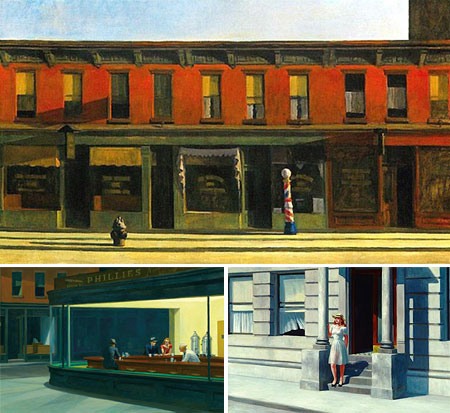
Edward Hopper found stillness in motion and geometry in light. His simultaneously strong and subtle images of houses, streets and intimate rooms invite us to quiet our minds and open our eyes to the beauty of the commonplace as revealed by shadow, sun and the warmth or artificial lights.

Hopper takes us down city streets, past rows of shops waiting to open, into cafes and diners, past intimate scenes on porches and stoops and lets us peer voyeuristically into windows. He doesn’t just leave us in front of his images, he guides our eye, saying look, look how the shadows show you this form, look how the sunlight makes this space reveal itself, look at the inside and the outside of this architectural form at the same time. Look.

Hopper, in addition to his fascination with shadow and light, had a fascination with architecture, not in the sense of advanced designs, history or monuments, but in the streets and houses and buildings we encounter every day. His fascination is in the corner of a storefront, the edge of an office building, the porch of a house or the corner of a room.

Hopper takes particular delight in showing us windows, all manner of windows, from the inside looking out, whether from quiet cafes or intimate bedrooms, or from the outside looking in, particularly in night scenes where the inside reveals itself more brightly in the surrounding darkness, or even in his famous Nighthawks diner scene where outside and inside are separated more by the presence of light than by the physical barrier of glass.

Hopper’s technique is deceptively simple, There is no great flourish of painterly display, or dazzling realist detail, he paints directly, almost brusquely, with little regard for anything but conveying the scene and, in particular, the geometry of the scene, all of the planes and angles and intersecting forms. Even his images of people are geometrically composed. A friend of mine recently remarked that Hopper paints his people exactly the same way he paints his architecture.

This becomes particularly apparent in an image like Summertime, in the collection of The Delaware Art Museum (above, lower right), in which the young woman almost appears to be part of the building, her red skin mirrored by the reds in the doorway, her white dress matching the facade of the building and its columns, and the translucent folds of which are echoes of the windblown curtains in the open window.

I think geometry is the key, whether Hopper ever thought of it that way or not, geometry, and his deep, vibrant colors, give his quiet paintings of unassuming scenes a remarkable strength.

Hopper started his career with a correspondence course with the Correspondence School of Illustrating in 1900. He later attended the New York School of Art, where he studied with William Merrit Chase, Robert Henri and Kenneth Hayes Miller. He supported himself for many years as an illustrator, but was not satisfied with that field and kept pursuing gallery representation unsuccessfully until the age of 40. Since then he has become one of the major figures of American art and his work has been the subject of major exhibitions at the Museum of Modern Art and the Whitney.

There is a terrific opportunity for those on the Boston, D.C. and Chicago areas to see major retrospective of Hopper’s work this year and next. The show, simply titled “Edward Hopper”, is at the Museum of Fine Arts, Boston, from now to August 19, 2007. It then moves to the National Gallery of Art in Washington D.C., where I hope to see it, for a run from September 16, 2007 to January 21, 2008, and finishes at the Art Institute of Chicago from February 16 to May 11, 2008.

The exhibit includes many of Hopper’s “greatest hits”, including Summertime, Chop Suey, Early Sunday Morning, New York Movie and Nighthawks.

The Museum of Fine Arts, Boston has a special feature devoted to the exhibit that includes an interactive tour of some of the works in the exhibition, though the images are small.

For a better overview of Hopper’s work on the web, try Bert Christensen’s Cyberspace Gallery, Art Renewal Center, or the other resources I’ve gathered for you below. Art Renewal probably has the largest reproductions, and perhaps the greatest number, as well as including some of Hopper’s etchings, but the color in their images of the paintings often look off to my eye. The reproductions in Bert Christensen’s Cyberspace Gallery are smaller, but their color is truer and he presents a nice selection.

Hopper, who struggled for years to sell a painting, is one of the most popular American artists and there are numerous reproductions and books of his work.

Share or bookmark this post:
  • Digg
  • del.icio.us
  • Facebook
  • Google Bookmarks
  • Mixx
  • Reddit
  • Sphinn
  • StumbleUpon
  • Yahoo! Bookmarks
  • Yahoo! Buzz
  • Twitter

7 comments for Edward Hopper »

RSS feed for comments on this post.

  1. Comment by Katherine
    Sunday, May 13, 2007 @ 12:04 pm

    Thanks for another informative article and links Charley. I’d already spotted the Boston exhibition but not the other locations. Shame the dates don’t work for me………

  2. Comment by Dan van Benthuysen
    Sunday, May 13, 2007 @ 6:30 pm

    The Edward Hopper House, his home for so many years growing up and home to relatives thereafter, Edward Hopper held the title to this home until he died in the 1960s. Today the house is a community art center in Nyack, a beautiful Hudson River town just north of NYC. Worth a visit via web or in person if you are in the area:
    http://www.hopperhouse.org/

  3. Comment by Bonnie
    Sunday, May 13, 2007 @ 10:30 pm

    I made sure to see the exhibit in Boston, It’s really fantastic, if it’s coming anywhere near you GO SEE IT. His use of color is amazing.

    Great show.

    Sadly, moves on in August

  4. Comment by Matt
    Monday, May 14, 2007 @ 12:43 am

    My wife and I really enjoy Hopper, so we’ll be checking out the DC exhibit in Sept no doubt. Thanks for the heads up on it. I cannot wait to stand in front of Nighthawks. Simply amazing.

  5. Comment by Daniel van Benthuysen
    Monday, May 14, 2007 @ 12:05 pm

    Hopper’s wife died only a year after he did and his entire estate went to the Whitney Museum of American Art. They have staged the quintessential blockbusters of Hoppers work at various points over the ensuing decades but last winter, perhaps figuring that New York audiences had zoned out on the every-few-years-giant-Hopper show, they hit upon something new: Displaying Nighthawks and New York Movie together with the dozens upon dozens of sketches (many from quite tiny pocket sketch-books) that refined the figure studies and compostions of several of his best known paintings. One saw several things in this show: How Jo Hopper was always the model for any female figure in his paintings. How her features became more generic as a compopsition developed so that in the end she was not recognizable. And how Hopper’s fascination with the tensions in the marvelous play of geometry in his compositions was ultimately at the cost of some stiffness that sets in, particularly in the human figures. As a painter myself, though, I was relieved to read that Hopper for many years was only painting two or three oils a year. What phenomenal preparation though!

  6. Comment by Don O'Shea
    Tuesday, May 15, 2007 @ 9:02 pm

    Charlie,
    Here’s a contrary view of Hopper from this week’s issue of the New Yorker: http://www.newyorker.com/arts/critics/artworld/2007/05/21/070521craw_artworld_schjeldahl
    Regards,
    Don O’Shea

  7. Comment by samiramiss
    Sunday, August 19, 2007 @ 5:07 am

    paint

Leave a comment

(required)

(required but not published)

 
Display Ads on Lines and Colors: $25/week or $75/month.

Please note that display ads for lines and colors are limited to art related topics and may not be animated.


Donate Life

The Gift of a Lifetime
Exhibitions
Drawing, Illustration and Comics
Updated 2/6/10
Norman Rockwell: Behind the Camera
Nov 7, 2009 - May 31, 2010
Norman Rockwell Museum, MA
The Art of Archie Comics
Nov 19, 2009 - Feb 28, 2010
Museum of Comic and Cartoon Art, NY
Illustrators 52: Book and Editorial Exhibit
Jan 6 - Feb 20, 2010
Society of Illustrators, NY
Drawings and Prints: Selectinos from the Permanant Collection
Jan 11 - April 11, 2010
Metropolitan Museum of Art, NY
Rome after Raphael (Italian Drawings)
Jan 22 - May 9, 2010
Morgan Library and Museum, NY
The Drawings of Bronzino
Jan 20 - April 18, 2010
Metropolitan Museum of Art, NY
Batman: Yesterday and Tomorrow
Jan 30 - June 6, 2010
Cartoon Art Museum, CA
Laugh Lines: Cartoons and Caricatures from the Collection
Jan 23 - March 14, 2010
Brandywine River Museum, DE
Dinotopia: The Fantastical Art of James Gurney
Feb 6 - May 16, 2010
Delaware Art Museum, DE
Illustrators 52: Advertising and Institutional Exhibit
Feb 24 - March 20, 2010
Society of Illustrators, NY
An Italian Journey: Drawings from the Tobey Collection, Correggio to Tiepolo
May 12 - August 15, 2010
Metropolitan Museum of Art, NY
German Drawings from the Wolfgang Ratjen Collection, 1580 to 1900
May 16 - Nov 28, 2010
National Gallery of Art, DC