Drawing is like making an expressive gesture with the advantage of permanence.
- Henri Matisse
The only difference between myself and a madman is that I am not mad.
- Salvador Dalí


Monday, December 24, 2007

Haddon Sundblom

Posted by Charley Parker at 12:01 am

Haddon Sundblom
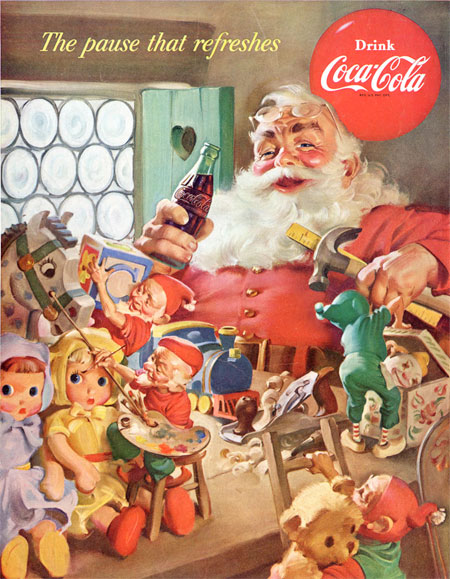
You will find many accounts that insist that Michigan illustrator Haddon Sundblom was responsible for creating the modern image of Santa Claus, providing a friendlier form for the the jolly old elf than had previously been envisioned, at the behest of the Coca-Cola company, who wanted to use him to sell more of their sugary, flavored soda water.

While the latter assertion is true, the former isn’t. The modern image of Santa as a red-cheeked, morbidly obese (according the current surgeon general) and preternaturally friendly old guy in a red suit, with white fluffy beard and cuffs to match, was created by illustrator extraordinaire J.C. Leyendecker. See my previous posts on J.C. Leyendecker (also here, here and here) and Illustrators’ Visions of Santa Claus.

Sundblom, who was also a terrific and currently underappreciated illustrator active in the early and mid 20th Century, didn’t create that image but did go along way toward continuing, refining and promoting the cultural icon to the benefit of the Coca-Cola company, who wanted a family-friendly, all-occasions image for their “soft-drink”, originally thought of as an alternative for “hard” alcoholic drinks and considered suitable only for similar occasions.

Sundblom created a fresh image of Santa for Coke ads each year from 1931 to 1964, featuring the jolly old guy chugging the “not for Summer only” beverage while in his elf labor camp workshop, leafing through the Big Book of Naughty and Nice (wouldn’t you like to see that one) or out on the road on his trans-global hypersonic toy dispersal run (in the course of which he always found time to stop and lounge on someone’s staircase, or lean against their refrigerator, to enjoy “The pause that refreshes”® in lieu of the more boring Milk and Cookies®).

The Coca-Cola company has a page devoted to Sundblom’s Santa campaign, but they get it wrong too, laying claim to introducing the modern version of Santa to the world with nary a mention of Leyendecker or Rockwell, who had been doing their Santa thing in the pages of the Saturday Evening Post for years before Sundblom’s Santa Appeared. (Gee, an American food-product company making unsubstantiated and inaccurate claims? Shocking! For further reference, I point you to an excerpt from Santa Claus: A Biography by Gerry Bowler.)

None of this detracts from Sundblom, however, who made no such claims and who contributed other well known embodiments of products to the 20th Century’s cultural zeitgeist, like Aunt Jemima (who has recently gotten a political correctness makeover and modernization) and the Quaker Oats Quaker.

Sundblom’s career as an illustrator, though overshadowed by his association with the big guy, was long and influential. He provided illustrations for companies like Ford, Maxwell House and Colgate Palmolive, and publications like the Saturday Evening Post, The Ladies’ Home Journal and Woman’s Home Companion. He also did some nicely teasing “cheesecake” pin-up art (thank you, Santa) for Playboy and others.

“Sunny” Sundblom, as he was often called, was influential on a number of notable mid-20th Century illustrators, like Harry Anderson, Art Frahm, Gil Elvgren and Joyce Ballentine.

One of the best sources on Sundblom’s overall career is on the American Art Archives. Leif Peng’s Flickr set is also good.

There are a couple of books available on his Coke Santas (possibly different editions of the same book), Dream of Santa: Haddon Sundblom’s Advertising Paintings for Christmas, 1932-1964 and Dream of Santa: Haddon Sundblom’s Vision.

If you’re good, maybe Santa will bring you one.

Share or bookmark this post:
  • Digg
  • del.icio.us
  • Facebook
  • Google Bookmarks
  • Mixx
  • Reddit
  • Sphinn
  • StumbleUpon
  • Yahoo! Bookmarks
  • Yahoo! Buzz
  • Twitter
Posted in: Illustration   |   9 Comments »

9 comments for Haddon Sundblom »

RSS feed for comments on this post.

  1. Comment by Sid Leavitt
    Monday, December 24, 2007 @ 1:42 pm

    Well, at the risk of violating a registered trademark, the pause that refreshes me is reading your blog every day.

    I don’t know how you find time to do all your excellent research, writing and posting, but I’m glad you do.

    Best wishes for the holidays and the new year.

  2. Comment by Dan van Benthuysen
    Monday, December 24, 2007 @ 2:00 pm

    But before Leyendecker and Rockwell there was Thomas Nast, Haprper’s Weekly cartoonist and newspaper artist otherwise known as the creator of such images as the Republican elephant, the Democratic donkey and the Tammany Hall Tiger. Nast took Santa from being a thin, grim, old man, not unlike father time, and made him fat and jolly in the post Civil War era when Clement Moore’s Night Before Christmas became popular.

  3. Comment by Kevin Turcotte
    Monday, December 24, 2007 @ 3:58 pm

    Great stuff — don’t forget Haddon Sunbloom also gave us that other icon of a religiously inclined, smiling white haired man — the Quaker Oats man! – Kevin

  4. Comment by peter
    Wednesday, December 26, 2007 @ 8:26 am

    Just echoing Sid’s comment, Charley – thanks for a solid year of brilliant choices and articles. Looking forward to seeing what you have for us in 2008!

    p

  5. Comment by Charley Parker
    Wednesday, December 26, 2007 @ 9:44 am

    Sid,

    Thanks for the kind words and good wishes.

    Other readers should check out Sid Leavitt’s Readers sand Writers Blog.

  6. Comment by Charley Parker
    Wednesday, December 26, 2007 @ 9:51 am

    Dan,

    Yes, you’re correct. But as I pointed out in my post on Illustrators’ Visions of Santa Claus last year, Nast got us a good part of the way there, but not quite all the way. I’m not sure how many people would recognize Nast’s Santa as the “modern version”, which is what I’m crediting Leyendecker with, but he certainly contributed greatly to the creation of the modern concept.

  7. Comment by Charley Parker
    Wednesday, December 26, 2007 @ 9:53 am

    Kevin,

    Right you are. It’s surprising how much these illustrators have become part of the visual texture of our lives without breaking into our immediate consciousness.

  8. Comment by Charley Parker
    Wednesday, December 26, 2007 @ 10:11 am

    Peter,

    Thanks.

    And my best wishes back to everyone for the new year!

  9. Comment by MustafaJackson
    Wednesday, November 19, 2008 @ 12:02 am

    Excellent article. I am a huge fan of Mr. Sundblum.

Leave a comment

(required)

(required but not published)

 
Display Ads on Lines and Colors: $25/week or $75/month.

Please note that display ads for lines and colors are limited to art related topics and may not be animated.


Donate Life

The Gift of a Lifetime
Exhibitions
Drawing, Illustration and Comics
Updated 2/6/10
Norman Rockwell: Behind the Camera
Nov 7, 2009 - May 31, 2010
Norman Rockwell Museum, MA
The Art of Archie Comics
Nov 19, 2009 - Feb 28, 2010
Museum of Comic and Cartoon Art, NY
Illustrators 52: Book and Editorial Exhibit
Jan 6 - Feb 20, 2010
Society of Illustrators, NY
Drawings and Prints: Selectinos from the Permanant Collection
Jan 11 - April 11, 2010
Metropolitan Museum of Art, NY
Rome after Raphael (Italian Drawings)
Jan 22 - May 9, 2010
Morgan Library and Museum, NY
The Drawings of Bronzino
Jan 20 - April 18, 2010
Metropolitan Museum of Art, NY
Batman: Yesterday and Tomorrow
Jan 30 - June 6, 2010
Cartoon Art Museum, CA
Laugh Lines: Cartoons and Caricatures from the Collection
Jan 23 - March 14, 2010
Brandywine River Museum, DE
Dinotopia: The Fantastical Art of James Gurney
Feb 6 - May 16, 2010
Delaware Art Museum, DE
Illustrators 52: Advertising and Institutional Exhibit
Feb 24 - March 20, 2010
Society of Illustrators, NY
An Italian Journey: Drawings from the Tobey Collection, Correggio to Tiepolo
May 12 - August 15, 2010
Metropolitan Museum of Art, NY
German Drawings from the Wolfgang Ratjen Collection, 1580 to 1900
May 16 - Nov 28, 2010
National Gallery of Art, DC