Contour drawing helps you see that the things you are drawing aren't things but rather shapes that intertwine and connect.
- Charles Reid
For sheer excitement you can keep movie premieres and roller-coasters. An empty white canvas waiting to be filled. That's the thing.
- Pam Brown


Sunday, February 10, 2008

Pieter de Hooch

Posted by Charley Parker at 11:17 am

Pieter de Hooch
Pieter de Hooch (pronounced de HOOGH, with a hard “g”) is a fascinating painter, both for his own oeuvre and for the inevitable comparisons to his brilliant contemporary Johannes Vermeer.

Like Vermeer, de Hooch is noted for his paintings of quiet, light-filled interiors, and occasional tranquil street or courtyard scenes. De hooch was for a time in Vermeer’s home town of Delft, where he painted many of his best known works, and was a member of the Painter’s Guild there.

Though little is actually know about either man, it’s a fair assumption that the two painters were influential on one another, if not in friendly competition, as many of their subjects and scenes are remarkably similar.

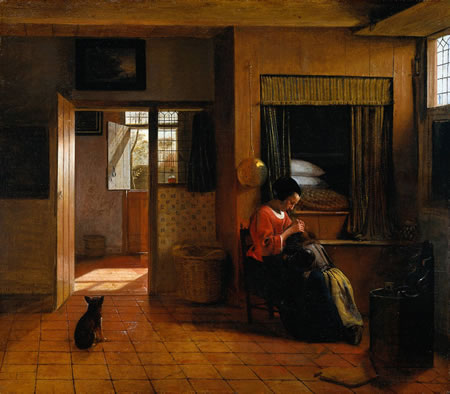
Many of the same themes are present in both painters’ scenes of domestic life within the tiled and wood beamed interiors of Delft homes: people reading a letter, sharing a drink or performing household chores (even, in the case of de Hooch’s painting above, de-lousing a child’s hair).

The two painters have different palettes, Vermeer choosing cooler backgrounds against which his brightly attired figures glow with the colors of rich fabrics, brilliant highlights and, yes, luminescent pearls; and De Hooch opting for warmer earth tones for his interiors, in which his more plainly clothed figures seem integral to their environment.

De Hooch’s depiction of the people in his scenes is warm and sensitive, but he doesn’t have the psychological insight of Vermeer’s intense personality studies, or the sense of mystery they invoke, and de Hooch’s figures are a bit stiff, almost as if they are portrayed as part of the rooms they inhabit, which are, I think, the real subject of his work.

De Hooch painted Dutch middle class life with a calm, steady eye and a remarkable skill for painting light and the texture of materials. He was a master of perspective, and the complex lines of his interiors are marvels of linear geometry.

Though he never achieved the transcendent mastery of time, space and light that made Vermeer so singular, (who did?), de Hooch was a master of light in a different way. Where Vermeer would bathe his serene interiors with a single golden source of light, that flowed in from windows on the observer’s left and spread through his compositions like atomized honey, de Hooch revels in multiple sources of light, bursting in though windows and doors, cascading through hallways and splashing on tiled floors in a complex dance of interior atmospherics.

De Hooch’s paintings are wonderfully layered; rooms give way to antechambers, which give way to other rooms, which lead through doors to courtyards; each with their own sense of atmosphere and light, worlds within worlds. This is what I love about de Hooch, and once I started reading about him, I discovered that many others do as well.

You will often hear reference to his “keyhole” paintings, compositions that offer glimpses of other scenes through open doors or windows. De Hooch, like Antonello da Messina in his amazing St. Jerome in his Study, invites us to walk into and through his paintings, beckoning us on a journey within a single image, and tantalizing us with glimpses of other vistas just beyond where we’re standing.

Share or bookmark this post:
  • Digg
  • del.icio.us
  • Facebook
  • Google Bookmarks
  • Mixx
  • Reddit
  • Sphinn
  • StumbleUpon
  • Yahoo! Bookmarks
  • Yahoo! Buzz
  • Twitter

8 comments for Pieter de Hooch »

RSS feed for comments on this post.

  1. Comment by Lane Meyers
    Sunday, February 10, 2008 @ 5:38 pm

    Snapshots of long, long ago. I wonder what inspired these artists.

  2. Comment by hemaworstje
    Monday, February 11, 2008 @ 12:16 am

    we dutch pronounce it as Hoogh
    the g is like gretzky

  3. Comment by Charley Parker
    Monday, February 11, 2008 @ 12:26 am

    Corrected. Thanks! (I had it as de HOKE from one of the online articles.)

  4. Comment by John Derry
    Monday, February 11, 2008 @ 8:33 am

    There has been a lot of research and speculation that the camera obscura played a part in the look of Vermeer’s work. Interior scenes certainly would have been the ideal lighting in which to utilize such a tool. I wonder if de Hooch perhaps had knowledge of the camera obscura? His emphasis on perspective within his interiors would seem to re-enforce the possibility.

  5. Comment by Charley Parker
    Monday, February 11, 2008 @ 1:46 pm

    Thanks for the comment, John. I think the evidence is very strong that Vermeer did use a camera obscura, and likely that de Hooch had access to one as well, though I don’t see the perspective quirks in his images that are part of the evidence scholars point to when analyzing Vermeer’s images.

    Other readers should check out John Derry’s site at pixelart.com. John is one of the originators of Painter, the amazing digital painting and image manipulation application originally from Fractal Design and now being sold and continuing to be developed by Corel.

  6. Comment by Sid Leavitt
    Monday, February 11, 2008 @ 8:45 pm

    God, Charley, I hate to be away from the Internet for a few days because there’s always so much good stuff on lines and colors to catch up on. (Wow, two prepositions. See how hurried I am?)

    Anyway, how in hell do you do it? And in two consecutive posts, spanning the distance from Gez Fry to Pieter de Hooch. I love it, but you’re exhausting me.

    Well, my wife says I need the exercise, so keep up the good work. And I’ll try to keep up, too.

  7. Comment by oakling
    Tuesday, February 12, 2008 @ 6:33 pm

    I love how much this looks like a really good modern photograph or movie still. I really prefer his use of light to Vermeer’s; I like the depth it gives the scene. Do you know of anyone doing similar work now?

  8. Comment by elijah
    Thursday, February 14, 2008 @ 6:53 am

    One of my favorite Dutch painters. I wonder if at least some of the paintings on these walls have been identified.

    I think another difference between the two masters is that Vermeer reveals more about the psychology of his models while De Hooch more about the psychology of his own persona. In a way it’s easier to identify with the latter because of that. But easy is not always that interesting, is it.

Leave a comment

(required)

(required but not published)

 
Display Ads on Lines and Colors: $25/week or $75/month.

Please note that display ads for lines and colors are limited to art related topics and may not be animated.


Donate Life

The Gift of a Lifetime
Exhibitions
Drawing, Illustration and Comics
Updated Sept 5, 2010
On Assignment: American Illustration 1850 - 1950
Mar 6, 2010- Feb 20, 2011
Delaware Art Museum, DE
Everyday Adventures Growing Up: Art from Picture Books
April 30, 2010 - Nov 28, 2010
Art Institute of Chicago, IL
Defining Beauty: Albrecht Dürer at the Morgan
May 14 - Sept 12, 2010
Morgan Library and Museum, NY
Storytime! Graphic Novels for Kids of All Ages
June 26 - Nov 14, 2010
Cartoon Art Museum, CA
Drawings and Prints: Selections from the Permanent Collection
July 13 - Oct 35, 2010
Metropolitan Museum of Art, NY
Mirror of Holland: Drawings from the Maida and George Abrams Collection
Nov 20, 2010 - March 6, 2011
Museum of Fine Arts Boston, MA
Witness: The Art of Jerry Pinkney
Nov 13, 2009 - May 31, 2011
Norman Rockwell Museum, MA
Eakins on Paper: Drawings and Watercolors from the Collection
Sept 4 - Dec 15, 2010
Philadelphia Museum of Art, PA
Virtues and Vices: Moralizing Prints in the Low Countries, 1550¥1600
Dec 2010 - Feb 2011
Philadelphia Museum of Art, PA
Blow Up: Hanuka, Shimizu, Weber
Sept 1 - Oct 16, 2010
Society of Illustrators, NY
German Drawings from the Wolfgang Ratjen Collection, 1580 to 1900
May 16 - Nov 28, 2010
National Gallery of Art, DC
Japanesque: The Japanese Print in the Era of Impressionism
Oct 16, 2010 - Jan 9, 2011
Fine Arts Museum of San Francisco, CA