


This post is out of date. See my more current special article on Pochade Boxes
This post was updated May 10, 2018.

 Though the practice by individuals can be traced back further, painting en plein air, meaning in the plain air or simply painting out of doors, was first practiced in significant numbers by artists in the Forest of Fontainbleau in the mid 19th Century.
Around that time, the advent of soft metal tubes for carrying paint and the development of the “box easel”, or “French easel” as it is more commonly known today (image at left), made it much more practical to carry painting equipment into the field. The practice was subsequently made even more popular by the French Impressionists, and by painters influenced by them in America and elsewhere.
Plein air painting has undergone something of a renaissance in the last 20 years or so, a phenomenon which seems to be growing. As in the 19th Century, there is new equipment that makes the practice easier and more practical, notably a new generation of pochade boxes.
Pochade is a French word meaning a small painted sketch, particularly one painted in oils, out of doors, and often in preparation for a larger, more finished work. I think it’s one of those French words that’s actually used more commonly among non French speakers. It’s derived from a 19th Century French verb, pocher, meaning to sketch.
A pochade box, then, is a portable painting box with a built in easel, meant to facilitate the creation of small alla prima paintings or sketches.
A pochade box shouldn’t be confused with a simple painting box, which holds painting supplies and a wooden palette, but has no provision for acting as an easel.
Modern pochade boxes are fitted with tripod mounts which allow them to be set up in an extremely flexible fashion, and carried to the painting site more easily than the traditional outdoor painting box/easel combination known as a French easel.
Portable easels
French easels are still in wide use and have many adherents, and they are better suited for some things, such as handling large scale paintings and stretched canvasses (as opposed to panels).

There are also a number of other types of dedicated outdoor portable easels for that purpose, like the Soltek, SunEden or Take-it-Easel (image above, left to right), or the Coulter Plein Air System (not pictured).
Some of these can be less expensive than a pochade box/tripod combination and are generally lighter and easier to set up than French easels, but are generally not as flexible or easy to adjust in terms of the position of the panel and palette as a pochade box mounted on a photographic tripod. If you haven’t decided on your ideal outdoor painting solution yet, you should give them a look.
I’ve recently added an article about these options:
French (Box) Easels, Field Easels and Other Plein Air Painting Systems
Pochade boxes
For small scale paintings, the pochade box is becoming the outdoor painting platform of choice.
Some will say that anything larger than 6×8″ doesn’t count as a “pochade”, but the modern boxes are bridging the gap between that definition and the function of French easels, the larger ones easily handling 12×16″ (30x40cm) panels or even larger.
I did a bit of research this year before acquiring my own pochade box, and I’ll try to give you the benefit of my rather exhaustive search with an overview of what I found.
Most pochade boxes are designed to handle flat painting panels, like primed Masonite, or canvas attached to a board, though some will also hold (but not carry) small stretched canvases.
Pochade boxes come in a variety of sizes, usually to fit standard size panels, such as 6×8″, 8×10″, 9×12″, etc. The smaller boxes are lighter but also have a smaller palette area, though most manufacturers offer palette extensions or add-ons of some kind, as well as ways of attaching fluid cups and holding brushes.
Most pochade boxes are primarily aimed at oil painting, but some of the manufacturers also have pastel or watercolor models, and oil oriented boxes can be adapted for watercolor with the addition of a watercolor palette, as many of them have panel holders that will open to a reasonably flat position.
Types of pochade boxes
 Pochade boxes fall into two major configurations; the first type, I’ll call “palette and panel only”, the second, I’ll call “all in one” (obviously not official terms of any sort).
The former is a combination of a recessed palette surface, usually a wood traditionally used for palettes, like birch (which some artists cover with a sheet of glass or plexiglass), with an attached, hinged panel holder, forming the easel. The whole unit has a standard photographic tripod mount underneath that allows for it to be adjusted and set in virtually any position when mounted on the tripod (Open Box M 8×10 above left)
The painting panel is held in place by a variety of mechanisms, depending on the manufacturer. There is also variation in the means of adjusting the angle of the easel back.
For the palette and panel style boxes, painting supplies and wet panels are carried separately, and the manufacturers often sell complete “kits” that fit into a wooden box, cloth bag or carrying pack.
 The “all in one” style pochade box not only provides a palette and easel, but also incorporates storage for painting supplies and/or the built in provision for carrying wet panels. (Alla Prima Pochade “Bitterroot” at left)
The advantage of the all in one style is that everything is in one unit, and, depending on the configuration, the painting supplies are at hand in drawers or compartments right there near the palette while you’re painting. The disadvantage is that the all in one boxes are bulkier and heavier, and require a more sturdy (and expensive) tripod.
“Palette and panel only” style pochade boxes

This is one of the most popular and well regarded manufacturers of this type of pochade box. They use a spring loaded horizontal clip system to hold the panels, which allows access to all parts of the panel without obstruction.
Their complete kit includes a walnut carrying box and matched wet panel holder. They also have lightweight kits with a soft pack instead of the outer box.
In addition, they make “palm boxes“, meant to be held to the hand with a strap instead of mounted on a tripod. You can also purchase the palette/panel holders separately, without the panel carrier and outer box.
I note that, among others, James Gurney, who is a dedicated plein air painter as well as a talented studio painter and illustrator, uses and recommends an Open Box M pochade box. I have a high regard for Gurney’s expertise. Gurney’s blog, Gurney Journey, has a number of posts in which you can see good shots of his Open Box M pochade box in use.
Open Box M has dedicated models for pastels and watercolor. The boxes range from 8×10″ to 12×16″. They also carry Manfrotto tripods and a line of plein air painting accessories.
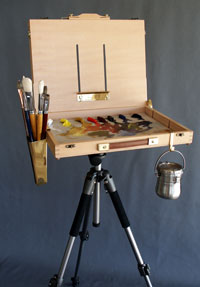
EASyL and ProChade are brand names for pochade boxes from Artwork Essentials. These also have their adherents among well known painters. Notably, Kevin Macpherson, who some of you may recognize as the author of some very popular (and quite good) books on painting, has given the ProChade model his official endorsement.
The EASyL and ProChade models use a vertical spring-mounted holder that does not restrict the size of the panel horizontally (though past a certain point, you would overload the box). The boxes range from 10×12″ to 12×16″.
The EASyL models (though not the ProChade) provide carrying for wet (or dry) panels in the back of the easel, placing them somewhere between the panel and palette style and all in one style of boxes. Some of the models offer a limited compartment separate from the palette area for carrying a few supplies. You can order a separator grid that fits in the recessed palette area for pastels.
When looking at the product pages on their site, note that they offer downloadable PDF files that go into more detail about the boxes than the web pages. There is also a PDF chart comparing their various boxes side by side. Their boxes come with a matched tripod.
Like Open Box M, Artwork Essentials carries a line of pochade box and plein air painting accessories, in their case one of the most complete, including a clamp-on lightweight umbrella and even plein air style picture frames.
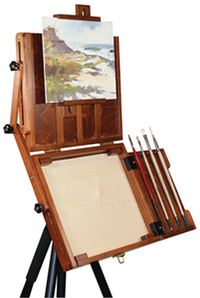
Sienna is a relatively new (to me) entry in the field, and has rapidly been adopted by art suppliers like Dick Blick and others, as well as by Amazon.
They offer a line of two sizes of pochade boxes, an optional Supply Box, a panel carrier, watercolor and pastel inserts, a Sienna branded tripod and a new line of separate panel and palette style portable easels.
The panel holding system is wood and seems reasonably flexible in terms of panel size, the larger box holding panels or canvasses up to 17″ (43cm) high and the smaller up to 15″ (38cm).
These boxes seem to offer a less expensive alternative to some of the other models in this category. I have to wonder, though, how well their wooden panel angle mechanism will hold up in comparison to the metal systems used by other makers.
Reader Paul Forest describes them as a good beginner’s box. See his comment on this article’s 2011 follow-up post.

The Strada Easel is essentially an all metal variation on a pochade box (most of which are made from wood). It was designed by painter Bryan Mark Taylor.
There area a variety of sizes. They also sell tripods and ballheads they feel are well matched to their easels.

Edge Pro Gear makes pochades that have a form factor similar to laptop computers, giving them a more modern look than some boxes.
The Paintbook and Sketchbook easels have glass palettes. Edge also carries appropriately matched tripods, detachable trays, lighting gear and other supplies.
Don Dos Santos has a review on Muddy Colors.
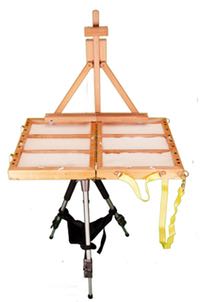
Edgmon makes a line of pochade boxes for pastel and watercolor as well as oil.
“All in one” style pochade boxes

This is the brand of pochade boxes you will most commonly encounter in retail settings, art supply stores and online art suppliers, along with newcomers Craftech Sienna, Mabef and some French easel manufacturers. The other brands usually have to be ordered directly from the manufacturer.
Judson’s has a line of pochade boxes and accessories and sell their own branded tripods as well. They show a typical setup for oils, watermedia and pastels.
The Guerrilla Painter boxes feature a compartmented space beneath the palette area, accessed by sliding the palette surface to one side. They are probably the deepest boxes on the market with the most space for supplies.
The hinged back holds two wet panels. If I understand the configuration correctly, one of them is the active panel, which is held in place by clips. The clips in this case do not appear to be spring mounted or adjustable, apparently limiting the horizontal size of the panel to the size of the box unless you use an optional adapter. They indicate that the box can accommodate larger panels vertically, but it seems to be one of the least flexible of the panel holder systems.
 Jusdon’s has more recently introduced an additional line of “French Resistance” pochade boxes (image at left), with a different configuration in which the box bottom, or a section of it, is the palette. These have a more flexible panel holder system.
Judson’s also sells umbrellas and a broad range of other pochade and general painting supplies and accessories. They also make small “ThumBox” models, with a thumb hole in the bottom, for holding like a traditional artist’s palette, in addition to the tripod mount. The thumb boxes are 6×8″ and the Guerrilla Box comes in 9×12″ or 12×16″ sizes.
Though tripods are not included with the boxes as they are with ArtWork Essentials, Judson’s site is helpful in that they offer separate tripods matched to their boxes, eliminating the need to guess at what’s appropriate.
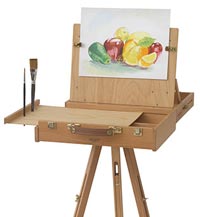
Easel manufacturer Mabef, who also makes French easels, offers a 13×16″ pochade box that handles panels up to 9×12″. It looks like there is storage for materials and two panels.
They also offer an accompanying wooden tripod that is somewhat unique in the field and is apparently based on their French Easel legs. While not as versatile or sturdy as a professional camera tripod, it’s relatively inexpensive.

This UK manufacturer of various styles of easels offers three pochade boxes, though it doesn’t look to me as though they can be tripod mounted and are evidently meant to be used on a table. One fits 203x152mm (8×6″) and the other 360x255mm (14×10″). They also offer a watercolor pochade box meant to fit an A5 pad in the lid.
It doesn’t look at though the lid angles are very adjustable.

This is a small “thumb” style box, meant to be held in the hand with the thumb through a hole in the bottom like a traditional palette. It’s made by Jullian, who manufacture the most popular French Easel, and branded for art supply company Utrecht. The box itself is 7×9″ and fits panels 6×8″ (horizontal) or 8×10″ (vertical).
The UK Jullian site (scroll down the page) shows them as sold with a set of paints and brushes and includes a panel sized at 22x16cm.

Alla Prima Pochade boxes are crafted by a single woodworker, Ben Haggett, though he is a full time dedicated pochade box maker as well as a plein air painter.
Alla Prima has a full line of sizes and styles and should be thought of in the same league with the larger manufacturers like Open Box M, EASyL and Guerrilla.
I have to make a bit of a disclaimer at this point.
After doing the research you’re getting the benefit of here, looking at all of the options I could find, and determining that my personal preference was for an all in one style box, I decided on one from Alla Prima Pochade. I was very impressed with the design, features and evident craftsmanship.
I then approached Haggett about redoing the Alla Prima Pochade web site, to which he agreed, and he is now my client. The web site you’ll see if you visit is the one I designed. So I can no longer say I’m unbiased; though I was when I initially made my decision to choose one of his boxes.
Haggett is wonderfully clever. His boxes feature several different configurations, based on the size of the box and the best solution he can design to accommodate carrying panels, brushes and other supplies in each. He also has unorthodox and clever solutions for the hinge mechanism, using torsion springs that eliminate the need for knobs or wingnuts.
His panel holder solution is equally unorthodox and remarkably flexible, consisting of a lower panel rest held in place by (uncommonly strong) magnets, that move in channels behind the panel holder, and a sheet-spring top clip. Like the EASyL models there is no restraint to the horizontal size, though you can only carry that so far without the box becoming unwieldy.
 Magnets also close the box lid, which holds four 1/8″ thick panels (or two 1/4″). The panel storage has a removable adapter that allows for carrying smaller panels, e.g. the 10×12 model can carry a 10×12, 9×12, 6×8 and 8×10 all at the same time. The magnets also make it easy to stick palette knives to the box when working, though palette knife painters have to be careful when painting in the vicinity of the bottom panel holder.
In the smallest, 6×8″, model, he uses a sliding palette to cover the storage bin, like the Guerrilla Painter configuration. In the 8×10, he has a single drawer. Both feature clip-on palette extenders.
The larger boxes, 10×12″ and 11×14″, utilize two drawers that can extend in a balanced manner when painting, one of which can hold a palette extension and both of which are drilled to serve as brush holders.
There are “lite” versions of his two biggest models – essentially palette and panel holder only variations with no drawers. They still incorporate brush and wet panel storage (2 panels instead of 4). Haggett can also build custom pochade boxes on request.
All of his boxes can be extended with optional “piggyback adapters” that tie into the box when closed (with magnets and a strap) to allow for carrying larger panels than the lid would normally accommodate (e.g. the 6×8 box can carry 8×10″ panels, the 10×12 can carry 12×16″). The piggyback can hang from the tripod when painting to serve as an extra bin.
The Alla Prima Pochade boxes themselves range in size from 6×8″ to 11×14″; the 11×14 can handle up to 14×18″ panels with its piggyback.
Like most of the other manufacturers, he also sells separate wet panel carriers for extra storage. Alla Prima doesn’t sell tripods, but Haggett does give a few suggestions.
Their are videos of Haggett demonstrating the boxes and how they work, that are also available on YouTube.
I got the 10×12 “Bitterroot” model (image at the top of the article shows my box in use) and I’ve been very pleased. The box is physically beautiful and a joy to use. My father was a woodworker and museum model maker and I know good woodworking when I see it. The cleverness is put to good use and the box is extremely easy to set up, and everything just seems to be exactly where I need it while painting. Plus the thing smells great.
Tripods

Except for some of the handheld models, most pochade boxes are fitted with tripod mounts, though you can certainly use them in your lap or on a table. I’ve mentioned in the course of the article that although some boxes come with tripods, most don’t.
Even the lightest boxes are heavier than most cameras, so your $30 K-Mart tripod probably won’t hold them very well except for the smallest models. For the all in one style, the largest of which can weigh in at 8-10lbs or more with paint and panels in them, you’ll want a sturdy professional tripod.
If you’re serious, look at a professional specialty camera store (as opposed to typical mall stores), if possible, take your pochade box with you. Some of the brands mentioned include Bogen (Bogen Junior or Bogen Digi), Velbon and Silk. James Gurney uses a Velbon CX 444 for his relatively light Open Box M. For my all in one Bitterroot, that has drawers for supplies in addition to the panel carrier lid, I went a little overboard and got a Bogen Manfrotto 190 (at left) and a 488 head (tripods and heads are often separate units at the professional level).
For those who have a heavy box like mine and want a cheaper option, you might investigate this Ravelli APGL3. I can’t speak from personal experience, but it looks suitable. There are a number of cheaper options, but I can’t predict their quality or stability. Reviews from buyers on sites like Amazon can sometimes be helpful if you can compare enough of them.
As Ben Haggett points out, though, a tripod for a pochade box doesn’t have to be rock steady as it does for a camera with a large lens, and you can often get away with overloading them beyond spec; as long as they don’t have a flimsy head or quick release shoe that will break under strain.
Check eBay, Craig’s List or your parents’ attic. You’ll be surprised how many tripods are gathering dust somewhere, waiting to be used.
Painting Panels

There are various sources for buying or making primed or canvas covered panels. I sacrifice money to save time and buy already prepared 1/8″ panels that fit easily into panel carriers.
I’ve used the smooth Ampersand Gessobord panels from Dick Blick and other art supply houses, and liked them fine; but I now prefer the real canvas surface of the Canvas Plein Air Panels from RayMar Art.
For those inclined to make their own painting panels, there are some resources on this Squidoo lens from Sue Favinger Smith and this step by step on Making a Canvas Board by Larry Seiler.
Box Sizes
When I give sizes for the boxes, it’s a reference to the size of the panels they hold, not their outer dimensions. For the benefit of those outside the US here is a rough conversion of common panel and box sizes:
6×8″ — 15x20cm
8×10″ — 20x25cm
9x 12″ — 23x30cm
10×12″ — 25x30cm
11×14″ — 27x35cm
12×16″ — 30x40cm
Do it Yourself pochade boxes
If you’re inclined to woodworking, or simple tinkering, there are some DIY options. I’ve moved the original content about them from this article into two more recent and expanded articles:
DIY Pochade Boxes – make your own cheap pochade box from simple materials
DIY Cigar Box Pochade Boxes – make your own cheap pochade box from a cigar box


