Drawing and colour are not separate at all; in so far as you paint, you draw. The more the colour harmonizes, the more exact the drawing becomes.
- Paul Cezanne
All art is autobiographical; the pearl is the oyster's autobiography.
- Federico Fellini


Wednesday, November 5, 2008

Thomas Cole

Posted by Charley Parker at 10:33 am

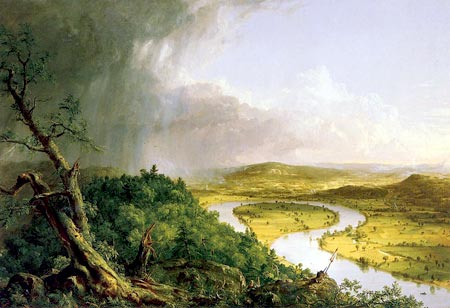
Thomas Cole - The Oxbow
Though often thought of as a quintessentially American painter, the founder of the Hudson River School of painting and even the father of American landscape painting in general, it is perhaps fitting that Thomas Cole was an immigrant, born in Lancashire England and moving to the U.S. with his family 1n 1818, when he was 18.

Cole spent a year on his own in Philadelphia before going on to join his family in Stubenville, Ohio, where he worked as a wallpaper designer for his father’s wallpaper factory. He later returned to Philadelphia for two years, and at the Pennsylvania Academy of the Fine Arts was inspired by the works of Thomas Birch and Thomas Doughty. He then moved to New York and devoted himself to the study of landscape painting.

He did a series of paintings after a sketching trip up the Hudson River that proved to be very successful and he began to accept commissions for works that displayed the grandeur and drama of the still largely unspoiled American wilderness.

Cole took several trips to Europe, refining his distinctly American art with the study of the European masters. He eventually settled in Catskill, New York. There is a Thomas Cole National Historic Site at Cedar Grove.

Cole had a distinct influence on other painters of the time, notably Asher B. Durand, whose famous painting Kindred Spirits was a tribute to Cole and his friend poet William Cullen Bryant; and the renowned painter Frederic Edwin Church, who was Cole’s only formal student.

Cole divided his attention between landscape commissions and large scale allegorical paintings of imaginary views that embodied philosophical ideals, such as a series showing The Voyage of Life, in four stages from childhood to old age.

The most famous of these is his grand sequence of five large canvasses depicting The Course of Empire, from the wilderness of an undiscovered continent to the pastoral beginnings of a young country to the heights of imperial glory and on to the inevitable destruction and collapse of an empire under its own weight.

Cole apparently preferred his ambitious allegorical works, but he is most often admired for his dramatic landscapes, with sweeping views of the wild and open country that still beckoned the American spirit of adventure and discovery.

The image above is alternately titled The Oxbow or The Connecticut River Near Northampton (larger version here and here).

It shows a long view of the American landscape, renewed and glowing in the sun as the darkness of a storm subsides.

Share or bookmark this post:
  • Digg
  • del.icio.us
  • Facebook
  • Google Bookmarks
  • Mixx
  • Reddit
  • Sphinn
  • StumbleUpon
  • Yahoo! Bookmarks
  • Yahoo! Buzz
  • Twitter

2 comments for Thomas Cole »

RSS feed for comments on this post.

  1. Comment by mike
    Wednesday, November 5, 2008 @ 12:33 pm

    I live right by the oxbow in Easthampton, MA, and have seen it dozens of times from Mt Holyoke. A very different place now from when it was painted. The Connecticut River Valley in Western Maaa is a place that has inspired many to paint and be creative.
    They don’t call it the Paradise Valley, and Northampton, Paradise City for nothing… Thanks for the inspiration…

    Mike

  2. Comment by MadSilence
    Saturday, November 8, 2008 @ 4:13 pm

    I’m a fan of the Hudson River School.
    I believe Cole’s Oxbow is in the Met. The image reflects the transformation of the American landscape.
    ~MadSilence

Leave a comment

(required)

(required but not published)

 
Display Ads on Lines and Colors: $25/week or $75/month.

Please note that display ads for lines and colors are limited to art related topics and may not be animated.


Donate Life

The Gift of a Lifetime
Exhibitions
Drawing, Illustration and Comics
Updated 2/6/10
Norman Rockwell: Behind the Camera
Nov 7, 2009 - May 31, 2010
Norman Rockwell Museum, MA
Drawings and Prints: Selectinos from the Permanant Collection
Jan 11 - April 11, 2010
Metropolitan Museum of Art, NY
Rome after Raphael (Italian Drawings)
Jan 22 - May 9, 2010
Morgan Library and Museum, NY
The Drawings of Bronzino
Jan 20 - April 18, 2010
Metropolitan Museum of Art, NY
Batman: Yesterday and Tomorrow
Jan 30 - June 6, 2010
Cartoon Art Museum, CA
Laugh Lines: Cartoons and Caricatures from the Collection
Jan 23 - March 14, 2010
Brandywine River Museum, DE
Dinotopia: The Fantastical Art of James Gurney
Feb 6 - May 16, 2010
Delaware Art Museum, DE
Illustrators 52: Advertising and Institutional Exhibit
Feb 24 - March 20, 2010
Society of Illustrators, NY
An Italian Journey: Drawings from the Tobey Collection, Correggio to Tiepolo
May 12 - August 15, 2010
Metropolitan Museum of Art, NY
German Drawings from the Wolfgang Ratjen Collection, 1580 to 1900
May 16 - Nov 28, 2010
National Gallery of Art, DC