Drawing and colour are not separate at all; in so far as you paint, you draw. The more the colour harmonizes, the more exact the drawing becomes.
- Paul Cezanne
All art is autobiographical; the pearl is the oyster's autobiography.
- Federico Fellini


Thursday, November 27, 2008

Giuseppe Arcimboldo

Posted by Charley Parker at 9:36 am


According to a saying that became popular in the 1960’s, you are what you eat.

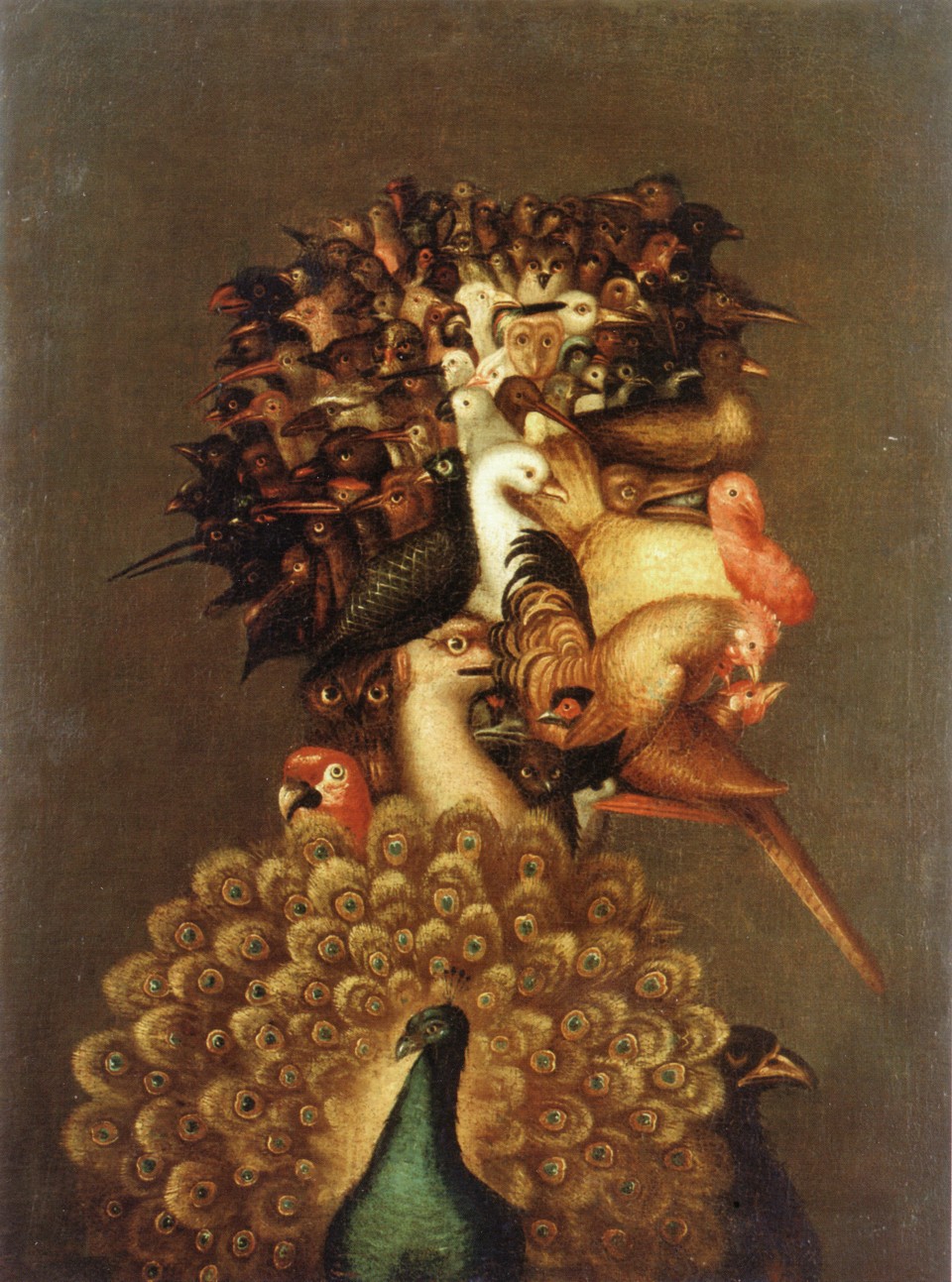
Perhaps not as directly as in the marvelous and bizarre portrait heads created by 16th Century painter Giuseppe Arcimboldo out of arrangements of fruit, vegetables, tree roots, fish, birds and other natural forms, but a sobering thought nonetheless as most Americans prepare today for a traditional Thanksgiving Day turkey dinner.

Born in Milan, Arcimboldo worked on frescos and tapestries in cathedrals in Italy and was also court painter to royalty in Vienna and Prague. Most of his traditional work has been lost, though a few examples survive, but his quirky and amusing portraits made from fruit, flowers and other elements of the natural world, as well as books and other man-made objects, remain, and attract attention to this day.

Some of his fruit/vegatable portraits were less obvious, disguised in what were ostensibly paintings of arrangements of vegetables in bowls, in which the face was revealed when the images was viewed upside-down, a precursor of the popular optical illusions circulated in later centuries. These upside-down portraits, when viewed in their orientation as paintings of fruit or vegetables in bowls, were, along with more straightforward images sometimes attributed to Caravaggio, among the earliest examples of still life as isolated subject matter for paintings.

The image above (large version here) is thought to be a likeness of Arcimboldo’s patron, Emperor Rudilf II, but it’s titular subject is Vertumnus, the Roman God of the seasons, whose penchant for changing his form to get what he wanted (like the favors of the goddess Pomona) personified the value of change in the practice of rotating crops to preserve the fertility of fields.

Arcimboldo’s striking visions have inspired others to follow in a similar vein, like contemporary painter Andre Martins de Barros (link contains NSFW material).

Arcimboldo’s paintings were celebrated by the Surrealists, who were always on the lookout for hallucinatory visionaries they could consider their precursors; and there has been some speculation that his inclination to see faces in arrangements of objects was the result of mental illness; a notion perhaps encouraged by his more disturbing images made of fish, birds and other animals, or the haunting images made of tree roots; but the truth is likely more prosaic. The Renaissance, a time of relative plenty and stability compared to the centuries that preceded it, not only provided the luxury of devoting more attention to art, but of indulging in puzzles, whimsies and amusement with the bizarre.

The luxury to enjoy the fruits of life beyond the necessities of survival, in particular the bounty of art, is always something for which to be thankful.

Share or bookmark this post:
  • Digg
  • del.icio.us
  • Facebook
  • Google Bookmarks
  • Mixx
  • Reddit
  • Sphinn
  • StumbleUpon
  • Yahoo! Bookmarks
  • Yahoo! Buzz
  • Twitter

4 comments for Giuseppe Arcimboldo »

RSS feed for comments on this post.

  1. Comment by Fabrizio
    Thursday, November 27, 2008 @ 10:52 am

    You probably want to correct the spelling of the name from “Guiseppe” to “Giuseppe”.

    BTW great blog! keep up the good work!

    Fabrizio

  2. Comment by Charley Parker
    Thursday, November 27, 2008 @ 11:22 am

    Thanks, tpyos are always sneaking up on me.

  3. Comment by Katherine
    Saturday, November 29, 2008 @ 9:50 am

    I saw this very painting just recently – face to face as it were. It’s in the current “Renaissance Faces” exhibition at the National Gallery in London. There are lots of terrific paintings in the exhibitions and it’s well worth going to see if you’re in London in the near future.

    There’s also a Taschen volume about Arcimboldo which is interesting.

    See my blog post Renaissance Faces at the National Gallery for further comments on the exhibition and links to details about it.

  4. Comment by Glendon Mellow
    Sunday, November 30, 2008 @ 11:38 am

    I completely agree with your assessment that his visions may have been due to time for creativity instead of mental illness.

    It bothers me when people attribute creative genius to drugs or mental illness. Archimboldo’s works were stunning, and in them I feel you can see the roots of Surrealism, optical illusions and fantasy. Absolutely stunning.

Leave a comment

(required)

(required but not published)

 
Display Ads on Lines and Colors: $25/week or $75/month.

Please note that display ads for lines and colors are limited to art related topics and may not be animated.


Donate Life

The Gift of a Lifetime
Exhibitions
Drawing, Illustration and Comics
Updated 2/6/10
Norman Rockwell: Behind the Camera
Nov 7, 2009 - May 31, 2010
Norman Rockwell Museum, MA
The Art of Archie Comics
Nov 19, 2009 - Feb 28, 2010
Museum of Comic and Cartoon Art, NY
Illustrators 52: Book and Editorial Exhibit
Jan 6 - Feb 20, 2010
Society of Illustrators, NY
Drawings and Prints: Selectinos from the Permanant Collection
Jan 11 - April 11, 2010
Metropolitan Museum of Art, NY
Rome after Raphael (Italian Drawings)
Jan 22 - May 9, 2010
Morgan Library and Museum, NY
The Drawings of Bronzino
Jan 20 - April 18, 2010
Metropolitan Museum of Art, NY
Batman: Yesterday and Tomorrow
Jan 30 - June 6, 2010
Cartoon Art Museum, CA
Laugh Lines: Cartoons and Caricatures from the Collection
Jan 23 - March 14, 2010
Brandywine River Museum, DE
Dinotopia: The Fantastical Art of James Gurney
Feb 6 - May 16, 2010
Delaware Art Museum, DE
Illustrators 52: Advertising and Institutional Exhibit
Feb 24 - March 20, 2010
Society of Illustrators, NY
An Italian Journey: Drawings from the Tobey Collection, Correggio to Tiepolo
May 12 - August 15, 2010
Metropolitan Museum of Art, NY
German Drawings from the Wolfgang Ratjen Collection, 1580 to 1900
May 16 - Nov 28, 2010
National Gallery of Art, DC