The important thing is to keep on drawing when you start to paint. Never graduate from drawing.
- John Sloan
A man should hear a little music, read a little poetry, and see a fine picture every day of his life.
- Johann Wolfgang von Goethe


Sunday, December 14, 2008

Anamorphic Art

Posted by Charley Parker at 11:49 pm

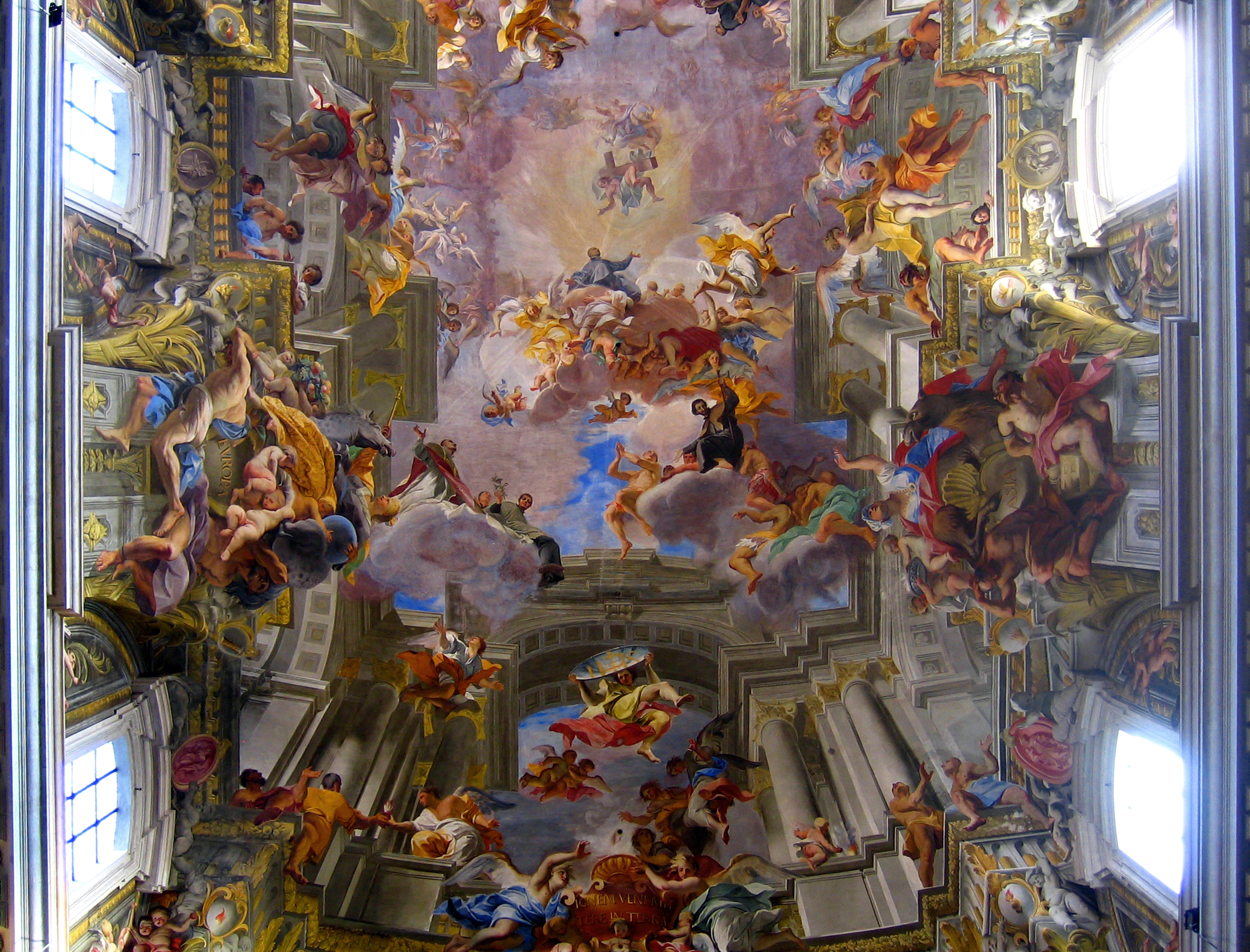
Anamorphic Art - Andrea Pozzo, Istvan Orosz
An anamorphosis is an image that is distorted in such a way that it only assumes the proportions of recognizable forms when viewed from a certain angle, or by reflection in a curved surface.

The term comes from the Greek anamorphoun, to transform. Anamorphic images have a long history in art. The earliest examples in Western art are found in Leonardo’s notebooks, though anamorphic images may have been developed in Chinese art around the same time.

Anamorphic perspective was employed in the illusionistic painting of church vaults, like those of Andrea Pozzo (image above, top, large version here) and Andrea Mantegna, but it has most often appeared in art as a curiosity or entertainment; or been used for the creation of hidden or secret images, requiring a matching mirrored surface to reveal their true nature.

Anamorphic images can be of as much interest to scientists as they are to artists, as NewScientist reports in their mention of a recent seminar on technical aspects of anamorophic art at the London Knowledge Lab; and an event at the National Gallery in London called Curious Perspective: Anamophosis in Art.

The NewScientist article is accompanied by a slideshow of anamorphic images.

The event at the National Gallery in London centered on the wonderfully enigmatic painting The Ambassadors by Hans Holbein the Younger, which is in their permanent collection. I devoted a post to The Ambassadors in 2006.

One of the notable modern applications of artistic anamorphosis that is missing from the NewScientist article (and many other resources) is the use of anamorphic images in sidewalk art, as exemplified by the work of Julian Beever and Kurt Wenner.

You can also add to the list the illusionistic point-of-view dependent paintings of Felice Varini and the modern continuation of traditional anamorphic art by István Orosz (image above, bottom). I’ve gathered some other anamorphic art resources below.

[NewScientist article link via Digg]

Share or bookmark this post:
  • Digg
  • del.icio.us
  • Facebook
  • Google Bookmarks
  • Mixx
  • Reddit
  • Sphinn
  • StumbleUpon
  • Yahoo! Bookmarks
  • Yahoo! Buzz
  • Twitter

9 comments for Anamorphic Art »

RSS feed for comments on this post.

  1. Comment by cognitive dissident
    Monday, December 15, 2008 @ 9:23 am

    I love this stuff!

    Have you ever seen the 6-point-perspective spheres painted by Dick Termes?

  2. Comment by allen mezquida
    Monday, December 15, 2008 @ 2:33 pm

    Hello. I want to tell you how much I love this site. I check in almost everyday. Really great stuff here.

    I’ve just launched a few of my animations that you may like. The series is called “SMIGLY”

    http://www.youtube.com/user/allenmez

    Take care and thanks again-Allen

  3. Comment by Frank Ordaz
    Monday, December 15, 2008 @ 7:01 pm

    Really enjoyed this post. I loved the Holbein at the National Gallery. I am still trying to fit an Anamorphic skull into one of my paintings….

  4. Comment by 3d Street Artists
    Tuesday, March 31, 2009 @ 4:29 am

    I just love these pics..they’re just amazing!

  5. Comment by Valentino
    Tuesday, January 26, 2010 @ 10:10 am

    The colors on St Ignacius ceiling jpg are over saturated (for clarity purpose, I suppose). I have recently had luck to visit St Ignatius and, of course, I took photographs of the famous fresco.
    FTI, the whole ceiling can be viewed here:
    http://tinoradman.wordpress.com/2010/01/17/andrea-pozzo/

  6. Comment by Charley Parker
    Tuesday, January 26, 2010 @ 12:54 pm

    Thanks, Valentino. That’s a great shot.

  7. Comment by Betty
    Thursday, February 18, 2010 @ 11:47 pm

    Holbien’s Ambassadors – on my 5 favorite paintings list because its an anamorphic painting as well as for the fascinating hidden symbolism of art of that time period. How do you manage to manage so much information Charley? As always, thank you. It really is fantastic to have access to your art forum. Betty

  8. Comment by Charley Parker
    Friday, February 19, 2010 @ 8:14 am

    Thanks, Betty. I enjoy finding these things and telling people about them, but I’m not sure how I manage the information either (grin).

  9. Comment by Arthur
    Saturday, March 13, 2010 @ 9:25 pm

    This is some nice research. Your blog is incredible. I am into the decorative arts and I am always looking for ways to incorporate ideas and learning as much as I can….

Leave a comment

(required)

(required but not published)

 
Display Ads on Lines and Colors: $25/week or $75/month.

Please note that display ads for lines and colors are limited to art related topics and may not be animated.


Donate Life

The Gift of a Lifetime
Exhibitions
Drawing, Illustration and Comics
Updated 5/18/10
Norman Rockwell: Behind the Camera
Nov 7, 2009 - May 31, 2010
Norman Rockwell Museum, MA
Drawings and Prints: Selections from the Permanant Collection
April 21 - July 4, 2010
Metropolitan Museum of Art, NY
An Italian Journey: Drawings from the Tobey Collection, Correggio to Tiepolo
May 12 - Aug 15, 2010
Metropolitan Museum of Art, NY
Defining Beauty: Albrecht Dürer at the Morgan
May 14 - Sept 12, 2010
Morgan Library and Museum, NY
Batman: Yesterday and Tomorrow
Jan 30 - June 6, 2010
Cartoon Art Museum, CA
The Pastoral Vision:British Prints, 1800 — Present
May 15 - Aug 15, 2010
Delaware Art Museum, DE
Earth: Fragile Planet
June 4 - July 31, 2010
Society of Illustrators, NY
German Drawings from the Wolfgang Ratjen Collection, 1580 to 1900
May 16 - Nov 28, 2010
National Gallery of Art, DC