


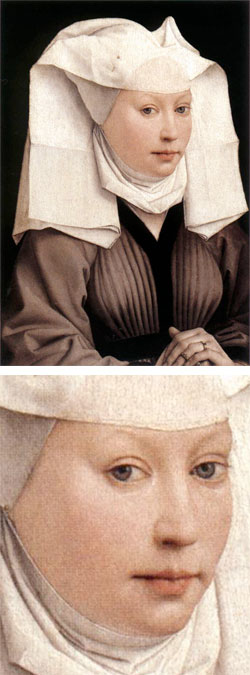
 Just as an individual artist struggles to learn the basics of drawing and painting, and works to progress into more sophisticated mastery of perspective, proportion, composition, and the ability to convincingly portray any desired subject, so too has Western art in general struggled to pass through those same stages.
Representational art started out as decoration and progressively moved toward less iconic and more “realistic” portrayals of people and other aspects of nature. The heights reached in Greece and Rome were lost in the “dark ages” and reclaimed or relearned in the time leading up to the Renaissance. Occasionally you see flashes of more naturalistic handling of subjects, particularly people, that presage later levels of accomplishment and understanding.
I think that Rogier van der Weyden (who changed his name from Roglet de la Pasture when he moved to Brussels) was one of those bright flashes.
Van der Weyden is presumed by scholars to have been a student of Robert Campin, and profoundly influenced by his silghtly older contemporary Jan van Eyck. Like Van Eyck he took up the new medium of oil painting and ran with it, realizing its potential to convey the world with more precision, detail and depth than the established medium of egg tempera.
He introduced some of the stylistic and compositional characteristics of Italian painting to the north and was instrumental in introducing the new technique of oil painting to the Italians (talk about picking it up and running with it).
He became, by the time of his death, the one of the most popular and influential painters in Europe, though he was afterward almost forgotten for hundreds of years, and much of what we know about him is through the research of scholars in the last century or so.
Unlike Van Eyck, Van der Weyden strayed from attempting to represent the world as accurately as possible and choose to infuse his work with more emotion, usually in the service of religious works. Occasionally he painted secular portraits, like the image shown here, usually simply called Portrait of a Young Woman or Lady wearing a Gauze Headdress. I’ve always found this painting in particular striking, standing out amid other work of the time like a red poppy in a green lawn.
It’s a beautiful face, rendered with confident draftsmanship and tonal subtlety, from the faint under-lighting of the folds of white fabric under her chin to the delicate Leonardoesque corners of her mouth. Wonderful. (And when I say “Leonardoesque”, bear in mind that Da Vinci wouldn’t be born for another 6 or 7 years.)
Here is where I may get a bit presumptuous in second guessing a great master, as something strikes me as a bit odd about her eyes. Yes, they too are beautiful, luminous green, holding our gaze with unwavering equanimity, with slight traces of lashes beneath absent brows (not uncommon in paintings of the time).
Look at her left eye, though (to our right), also delicately modeled, also beautiful; but isn’t it essentially the same beautifully modeled shape as her right eye? An eye in that position should be more rounded to reflect it’s position on the spherical axis of the head. Also the shape of the eyes seems oversimplified, almost iconic. I think you can see the artist appear to have some difficulty with the shape of eyes in other paintings and drawings as well.
Though he may have been free in his interpretation, intentionally giving the eyes in this portrait an artificial symmetry, I think Van der Weyden is painting partly what he sees and partly what he knows, struggling a bit with the accurate representation of reality as is actually is, and, in a way, representing the whole of Western art as it worked to improve its grasp of this process of capturing the world with brushes and paints.


