


Those who think they don’t like dusty old Renaissance paintings of religious scenes might find themselves delightfully surprised if they took time to investigate some of the Renaissance painters more closely.
There are astonishingly great painters in the history of art who often get less contemporary attention than they might because they are are eclipsed by the brighter stars of better known figures. One of these is the late Fifteenth, early Sixteenth Century Venetian painter Giovanni Bellini.
Bellini was on the cusp of several shifting paradigms, the shift from Gothic revival painting to the first flowering of the Renaissance, the shift from egg tempera to the remarkable new medium of oil painting (see my post on Rogier van der Weyden); and the adoption by painters of new ways of handling color and atmosphere, new methods of modeling the human face and form and new approaches to the representation of landscape, all of which were in part related to his experimentation and influence.
Bellini is considered the founder of the Venetian school of painting, and instrumental in the elevation of art from that city to a status in league with Rome and Florence, no small feat. His father, Jacopo Bellini, was an artist and one of the founders of the Renaissance style of painting. His brother, Gentile Bellini became a noted painter and official portrait artist of the Doges of Venice; and his brother in law was the painter Andrea Mantegna, quite a family.
Even in his early work in tempera, Bellini strove to convey the characteristics of natural light in the background landscapes of his paintings. Landscape as an art in itself would not really appear for centuries, but within the context of his religious themed paintings, Bellini was one of the great landscape artists. He brought to his landscapes, and to his figures and faces, a higher degree of realism and skillful modeling than his immediate predecessors and most of his contemporaries.
He experimented with the new medium of oil paint to great effect, achieving rich glowing passages of of color in layered glazes that paved the way for the painters of the High Renaissance who would follow.
He was also instrumental in introducing elements and techniques from the early masters of the Northern Renaissance to Venetian painting and Italian painting in general. Durer visited Bellini in Venice, and in 1506 wrote of him “He is very old, and still he is the best painter of them all.”
Giovanni Bellini became the official painter of the Venetian Republic (Venice was at the time an independent city-state), and the master of its most prestigious school; but his accomplishments were eventually outshone by those of his remarkable students Giorgione and, in particular, Titian.
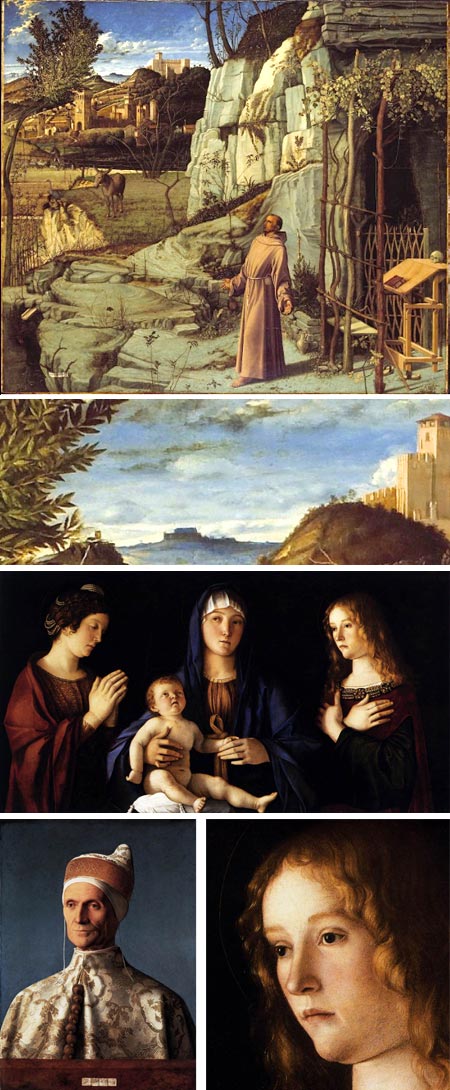
The image at top, with a detail below it, is St Francis in the Desert, sometimes called St. Francis in Ecstasy. It is in the Frick Collection in New York, and it is quite amazing. The Frick web site has a zoomable version of this image, along with a selection of detail images which show fascinating details like a rabbit emerging from his burrow, just under St Francis’ outstretched right hand (the painting is full of understated religious symbolism).
The image at bottom left is a Portrait of Doge Loenardo Loredan, then Doge of Venice, and is remarkable not only for its realistic portrayal and the powerful presence of the face, but the beautiful rendering of his intricate garment.
Third down and with a detail at bottom right is Madonna and Child with Two Saints (detail here, click for enlarged version in each case), which shows Bellini’s beautiful naturalistic rendering of faces, where he has incorporated lessons learned form his contemporary Antonello da Messina, and is approaching the style of the High Renaissance.
There are many resources on the web for Giovani Bellini (and deservedly so), and I urge you to spend a few minutes exploring his wonderfully strange compositions, his remarkably rich and human portraits and the astonishing intricacies of his sculptural landscapes.
Look in particular at the resources where large reproductions of his images can be found, like WGA, ARC, and the individual museum listings, which often have zoomable images.
(My comment in the first paragraph about visual development artists and contemporary landscape painters who think they don’t like Renaissance painting only applies to a few, of course, but I wanted to specifically get their attention. One of my main goals with Lines and Colors is to get people to cross boundaries and discover treasures they’ve been missing.)

