Opportunity is missed by most people because it is dressed in overalls and looks like work.
- Thomas Edison
A thimbleful of red is redder than a bucketful.
- Henri Matisse


Thursday, February 11, 2010

Fernando Botero

Posted by Charley Parker at 1:06 pm

Fernando Botero
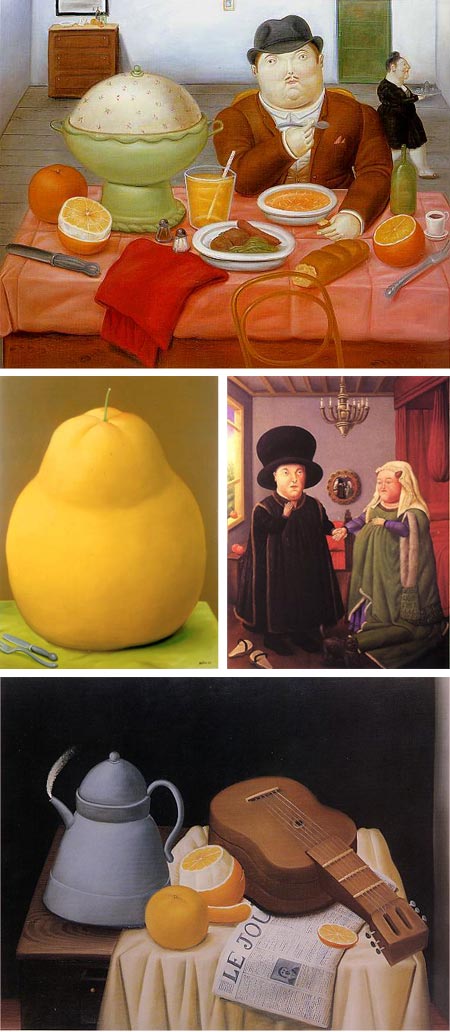
Fernando Botero Angulo, often known simply as “Botero” is a Colombian artist known for his exaggeratedly rotund figures and still life subjects.

Botero started his artistic career as an illustrator, before that attending an matador school for two years. He also worked as a set designer.

In 1953 at the age of 21, he moved to Paris. Reportedly, he spent much of his time there in the Louvre, studying in particular the masters of the Baroque period, and becoming fascinated with the work of Rubens. Botero counts Rubens, an artist also known for his filled out figures, as a major influence.

Botero also studied in Madrid and Florence, and spent time in mexico studying the murals of Rivera and Orozco.

Botero’s work has received wide recognition and is popular in many circles.

The distortions evident in his rounded figures are there in his still life paintings as well, which also use exaggerated scale (note the utensils in the still life of the single pear in the image above, middle left).

Botero is also a sculptor (see this gallery on Wikimedia), and his sculptures carry the rounded masses of his figures to monumentality in large scale bronzes.

His subjects can be topical and serious, as in his Abu Ghraib series from 2005; or whimsical and humorous, as in his delightful parodies of works from art history, like his version of Jan Van Eyck’s Portrait of Giovanni Arnolfini and his Wife (image above, middle right, larger here).

One aspect of Botero’s work not evident in reproduction is the scale of his paintings. Many of them are quite large, and the effect of seeing them in person is much more dramatic than seeing them in reproductions.

The Baroque World of Fernando Botero is a traveling exhibition that I caught last year at the Delaware Art Museum. It is currently on display at the Museum of Fine Arts in St. Petersburg, Florida until April 4, 2010.

Share or bookmark this post:
  • Digg
  • del.icio.us
  • Facebook
  • Google Bookmarks
  • Mixx
  • Reddit
  • Sphinn
  • StumbleUpon
  • Yahoo! Bookmarks
  • Yahoo! Buzz
  • Twitter

12 comments for Fernando Botero »

RSS feed for comments on this post.

  1. Comment by Cintia
    Thursday, February 11, 2010 @ 3:18 pm

    I love this blog, so that’s why I have a correction to make: Botero is a Colombian artist… :)

  2. Comment by Tim
    Thursday, February 11, 2010 @ 3:21 pm

    I hate to nitpick, but it’s Colombia, never Columbia, even in English. I’ve been to the Botero museums in Bogotá and Medellin (as Colombia’s unquestionably preeminent artist, many Colombian museums can be considered Botero museums), and you’re absolutely right about the scale — some of his paintings are as massive as his subjects. His sculptures have a wonderful sense of heavy permanence to them as well.

  3. Comment by Charley Parker
    Thursday, February 11, 2010 @ 3:54 pm

    Thanks. Corrected.

  4. Comment by Daniel van Benthuysen
    Thursday, February 11, 2010 @ 5:33 pm

    Art historians and doctors have theorized that an eye disease or disorder might account for the elongated quality of the figures painted by el Greco. We may never know if that was the case. But Botero’s world, populated by a race of super-corpulent people and objects, a world, one might say, ruled by the morbidly obese, will surely give future art historians something to puzzle over. Rubens at least knew portion control.

    The effect of transforming the known world into a world populated only by fat folk and fat objects creates an effect on the viewer that drifts toward humor. This is not the world of Bruce Willis; it’s the world of Benny Hill.

    I’m not quite sure why I and others have this reaction. After all, Giacometti painted and sculpted a world full of very thin people and neither the intent of the artist nor the effect of HIS work seem humorous. But given the smiles and chuckles Botero’s work elicits, what, then, are we to make of his Abu Grahib paintings, where still more fatties obscenely abuse other captive fatties? Why did Botero think the events at Abu Grahib needed to be portrayed as amusing?

  5. Comment by Tim
    Thursday, February 11, 2010 @ 5:52 pm

    Daniel, I can’t agree with your reaction to Botero’s work. While it is superficially playful, it does not really amuse me. I find it often frightening, grotesque, confounding, and beautiful, but not funny. To me, Botero’s world is a cynical place that is not about things being fat but things having volume, inflated importance. Maybe fat = funny is an American perspective. Keep in mind that in Colombia, Botero’s obese subjects can rarely be found “in the wild”. Of course, he did live in the US for a time.

    I strongly recommend trying to see his work in person, though. The Museo Botero made an incredibly strong impression on me; previously, I was not a big fan of Botero.

  6. Comment by Charley Parker
    Thursday, February 11, 2010 @ 7:02 pm

    I was also not that impressed with Botero’s work until I saw it in person.

    While I see his parodies of works from art history as amusing, in general, I don’t see the rest of his work that way.

    Perhaps instead of “fat”, it would make more sense to think of his figures as “distorted”, as in a fun house mirror. (Can a pear or a guitar be “fat” in the same sense as a person?)

    At his best, Botero uses his distorted figures to do what great art does best, to change the context of the visual world, and make us see the ordinary around us in a different way, even if only for a few minutes.

  7. Comment by Charles
    Thursday, February 11, 2010 @ 7:44 pm

    I’m not such a fan of Botero’s either. I’ve always found his work really very empty, he seems like just a painter of superficial decorative scenes, distinguished and set apart only by the novelty of the voluptuousness.

    This is not to say that I’m against Botero or his admirers, just that for me I really don’t see what’s appealing or interesting in his work once you get past the inflated sizes. To me there seems as much depth and impact to his work as you’d find in a drawing of Bugs Bunny.

  8. Comment by Valentino
    Friday, February 12, 2010 @ 12:33 pm

    I tend to agree with Charles.
    In my view Botero is one trick pony (a judgement based on several dozen of his paintings that I’ve seen).
    His artistic logic and raison d’ etre is too obvious. Once you get it (after ten or so images) the paintings become uninteresting and boring. Even irritating (to me).

  9. Comment by Ashley
    Thursday, March 11, 2010 @ 4:02 pm

    I completely agree with Charles. I am a student at the University of South Florida and recently went to see Botero’s work on display at the St. Petersburg Museum of Fine Arts for an Intro to Art class. I will admit that I don’t know much about art yet, but from what I’ve seen and learned so far, I do prefer art that has more of a deeper meaning to it. I was deeply humored by some of his works, especially when I first saw them and realized that his paintings looked as though someone had stretched them out horizontally. However, after looking at all of his works, I couldn’t find any meaning an most of them (there were a few paintings that symbolized the moral of not taking too much pride into possessions), which got boring after a while. However, I did find The Bath and Picasso in Paris to be very humorous.

    I don’t mean to criticize so much, but it’s just my opinion… I also felt as though he’s not that good of a painter. One of the hardest parts about creating art is proportion, but Botero skimps out on that and his works look like anything I could’ve made in 5th grade. It just makes it hard for me to take his work seriously. I do enjoy it for the humor, though.

    P.S. Thank you for the page–it’s helped with my report greatly. It’s nice to know that I’m not the only one criticizing his work.

  10. Comment by M. F. Luengas
    Saturday, January 8, 2011 @ 7:03 am

    Botero is not a bad painter, but is not great either. I think that his problem is
    the fact that he never evolved as an artist.
    He keeps doing what he was doing 50 years ago
    and that makes it really boring to see his work. I dont thing this guy is very awere of the changes in the contemporary world.
    There are no surprises in looking at his work. Now I wonder if is not that he is afraid of not been successful in doing something different.

  11. Comment by Fernando Da Costa
    Monday, January 9, 2012 @ 11:38 am

    One has to see the real stuff to get an understanding of it. I recently discovered Botero in the Medellin museum. I think Botero is a very misunderstood painter. His paintings do carry a deep meaning and are in no way superficial. I often see comments mentioning his exaltation of the sensuality of fat people, but I think it is a mistake. The people he paints never smile, and most of them are in fact really scary. They are greedy, and over inflated by their own greed. This is a world of morbid disease we have in front of our eyes, a reflection of our society. Even objects become scary, as a huge stove, in a kitchen with a little boy hiding behind a door. The size of the people gives an idea of how they carry the heaviness of reality. This is not a funny world, it’s a scary one. I had a wrong impression initially, seeing reproductions and having the feeling of “one trick” painter, as mentionned above. I was wrong. Botero is a great painter, who conveys a merciless and cruel vision of the world, with a great quality of execution. See it for yourself…

  12. Comment by Charley Parker
    Monday, January 9, 2012 @ 11:49 am

    Thanks, Frenando. I don’t know if I’ve gotten his meanings, but I will certainly agree that his work is much different, and has more impact, in person than in reproductions.

Leave a comment

(required)

(required but not published)

 
Display Ads on Lines and Colors: $25/week or $75/month.

Please note that display ads for lines and colors are limited to art related topics and may not be animated.


Donate Life

The Gift of a Lifetime
Exhibitions
Drawings, Illustration & Comics Art
Listed by start date
Updated July 13, 2011
Escape To Adventure: Focus on Arthur E. Becher
Mar 19 - Dec 31, 2011
Delaware Art Museum, DE
Italian Master Drawings from the Wolfgang Ratjen Collection: 1525 - 1835
May 8 - Nov 27, 2011
National Gallery of Art, DC
Two Masters of Fantasy: Bresdin and Redon
May 25, 2011 - Jan 16, 2012
Museum of Fine Arts Boston, MA
It's a Dog's Life: Norman Rockwell Paints Man's Best Friend
June 25 - Nov 11, 2011
Norman Rockwell Museum, MA
Fantastic Worlds: Masters of Science Fiction and Fantasy Art
Aug 13 - Nov 13, 2011
Kenosha Public Museum, WI
Comics at the Crossroads: Art of the Graphic Novel
Aug 20 - Nov 27, 2011
Boise Art Museum, ID
N.C. Wyeth's Treasure Island, Classic Illustrations for a Classic Tale
Sept 10 - Nov 20, 2011
Brandywine River Museum, PA
Infinite Jest: Caricature and Satire from Leonardo to Levine
Sept 13, 2011 - March 4, 2012
Metropolitan Museum of Art, NY
Honoring Howard Pyle: Major Works from the Collections
Sept 17 - Nov 17, 2011
Brandywine River Museum, PA
Inspiring Minds: Howard Pyle as Teacher
Sept 17 - Nov 17, 2011
Brandywine River Museum, PA
Howard Pyle: American Master Rediscovered
Nov 12, 2011 - March 4, 2012
Delaware Art Museum, DE